

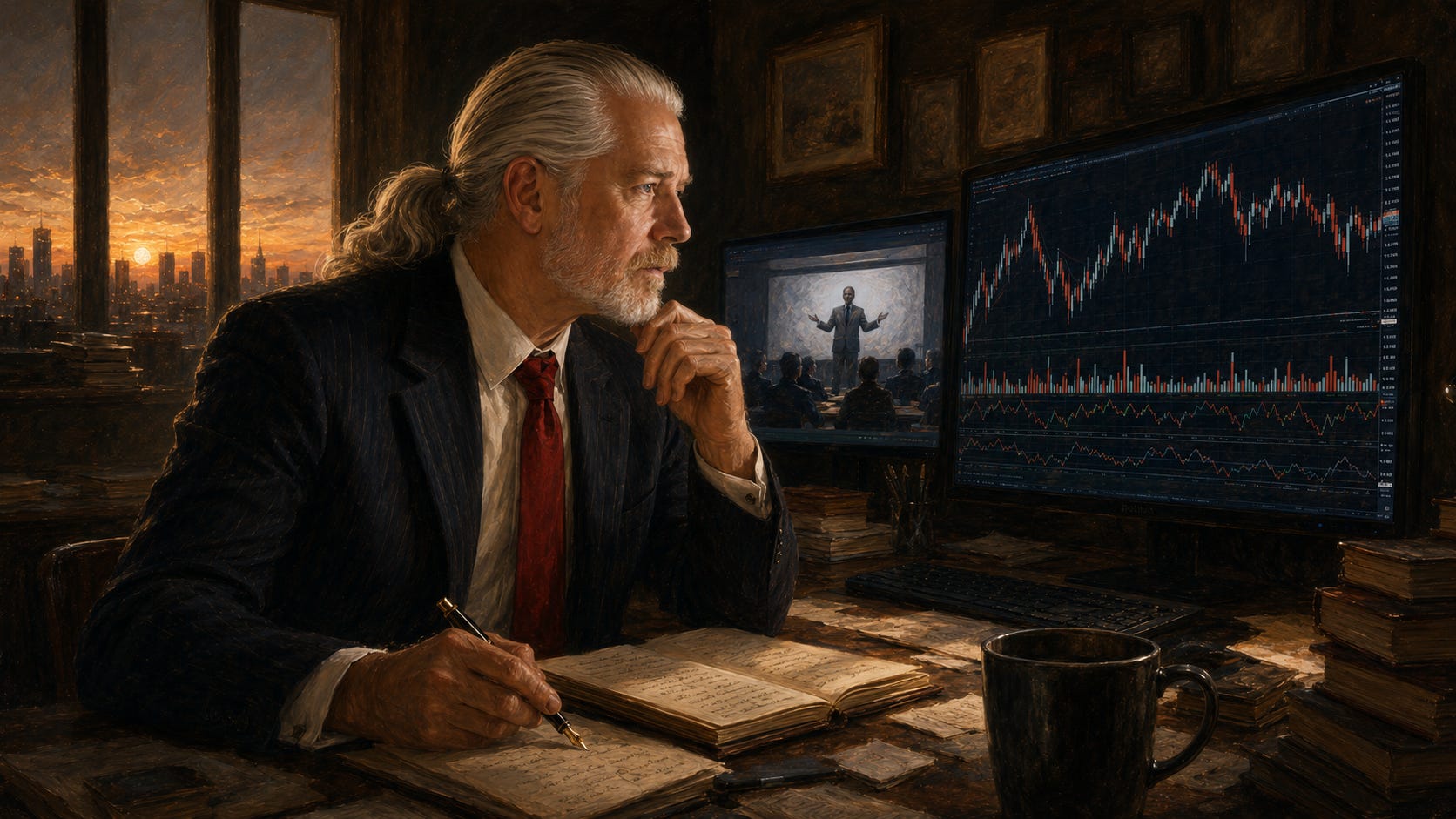
The morning starts early. I no longer even remember what time I’ve been getting up the last almost two weeks. I only know that I’m on the edge of something that seems to work. It works for me. It works even better for my host.
Ross Cameron is my host at Warrior Trading. I’ve been trying out his two-week trial. I love it so much that I’m considering transferring hundreds of thousands of dollars away from Schwab because — despite me requesting it now over 20 times and despite that it should be super-easy to program — they won’t give us 10-second candlestick charts.
Ross does other things, too. But I’m not privy to all of them because I’m on this two-week $20 trial plan. I get to watch some classes he teaches. I get to watch him do some trading. Problematically, the war started right about the same time I signed up, so I don’t actually get to see a lot of trading. (I contacted support about this, and they gave me a little additional time because I’d not gotten to see Ross trade. So kudos to them for that.)
Ross Cameron has, in many ways, been a godsend for me. I started trading at the very end of October 2025. At that time, I had about $1,600 in my “trading” account. The scare quotes are because I didn’t have a trading account. I happened to have a traditional IRA at Schwab.
I’m almost ashamed to admit that — I discovered this because I was thinking about retirement and doing an inventory — I had $100,000 sitting at Citi collecting $1.89 per month in interest.
And so I said, “Let’s transfer some of that to Schwab because I heard they have trading accounts.” And so they did. And so I did.
Then I bought some books on day trading, swing trading, technical analysis, psychology of trading, losing your entire life’s savings, and whatever other kind of books relating to what I was about to do that I could find.
And I found Ross Cameron.
Ross looked like the real deal. And, frankly, I still think he is. Well. Kinda. Sorta. Maybe.
No, I still think he really is the real deal. And I’m going to say why later in this article. But for a hint? There’s what “before” and there was the “after” (which is now).
But here’s the interesting — maybe the most interesting — piece of my not getting to see Ross trade because of the war: since I didn’t get to see Ross trade, but I did get access to the tools, I might have learned more.
My favorite things were the 10-second charts. They blew my mind. Schwab’s thinkorswim platform offers one-minute-or-above charts. That’s it. You want 30-second charts? Schwab says, “Fuck you. Just give us your money.” You want 10-second charts? Schwab says, “Fuck you AND give us your money.”
We’re never going to get 10-second charts from Schwab. (Which is why I’ll probably be transferring a few hundred thousand dollars, between my account and my wife’s account, to someone else quite soon. Fuck YOU, Schwab!)
Anyway, Ross. You can watch the same video I watched that “exposed” him, if you want. The video’s by a guy named Lance Breitstein, who runs his own trading-education shop, and he’s actually pretty good. We’ll dig into the implications — and errors — of this later, but the gist of it is this: Ross really is (mostly) transparent.
Are Receipts the Real Read?

So here’s the thing. What attracted me to Ross is not only that what he said actually made sense to me, based on all the books I’d been reading about how to trade, but he seems to be so transparent.
You try to look at Treyding Stocks, for example. I follow him and watch his videos, too. Because he’s one of the few people I’ve found who seems to focus on thinkorswim, which I use. And he discusses thinkscript, which I’m trying hard to learn. But this guy won’t even tell you his real name, let alone tell you about his real trading profits or try to document his abilities! Don’t get me wrong — I already said I follow him and watch his videos — but I do all that with a huge grain of salt because I’ve no idea who he is or whether he is successful.
That said, if you look at most of the “traders” selling their courses online that promise to make you into the world’s most fantabulist trader in the world…as Joey used to say, “Fuggidaboutit!”
Ross, on the other hand, publishes what at least purport to be audited returns relating to his actual trades and income.
But Ross goes farther than that. He creates videos that show his trades in progress and conducts a post-mortem on them. (He also allows people to watch him trading live. We’ll get to that anon.) And he doesn’t hide the warts. On videos like that — and there are more than just a few — he talks about losing trades, red days, max red days. He explains what he was thinking or what he was feeling and he tells you why the thinking was wrong and the feeling was a warning ignored.
If you’re not trading stocks yourself, you might need a little explanation:
All right, I’ve hit my max loss. I’m, I’m done for the day.
— Ross Cameron, Max Loss Red Day... (April 6, 2026)
And, as I said, he’s not afraid to admit to his losses. Then he turns them into additional teaching moments in which you see that he’s reminding himself — he’s not just the teacher, but another student — of the vagaries of trading.
This honesty, this openness, this embrace and explanation of the reality — most people are not going to get rich trading — is not just what convinced me to sign up for his $20 two-week trial. It’s what differentiates him from so many other online traders offering educational courses.
Reading While Being Read
Yesterday, I had the privilege of hosting my first-ever guest post. I’ve been writing on the Internet since the 1990s and have never had a guest post.
And I was blown away. The post you’re reading now was already being written and the guest post slotted right in between my own The Traded Self: When the Tape is Reading You and this post. The Traded Self and The Ghost in the Machine is Reading Your Tells both talk about surveillance. The Inquisitor — the writer of The Ghost post — notes something particularly useful for where we’re going next.
You aren’t merely the observed. You are also, over time, the observer of yourself being observed.
— The Harlequin Inquisitor, The Ghost in the Machine is Reading Your Tells: On the Epistemology of Being Badly Profiled, and Why You Should Be Worried Even If the Algorithm Is Wrong (May 10, 2026)
Lance Breitstein hits this note in his video reaction to Ross Cameron when he starts talking about his “Disclaimer” regarding Ross. After having agreed that Ross appears to be a good trader, practices transparency, and is essentially one of the good guys and not a bottom-feeding seller of bogus education like so many in this space, Lance argues there is a bit of problematic reflexivity.
The problem from his point of view is that Ross is trading live before “thousands” of other traders. Some of those traders are going to piggyback on his trades. This piggybacking is going to provide momentum, particularly because a part of Ross’s Five Pillars strategy is that he’s trading low-float stocks. Low-float stocks, by definition, are in low supply. Generate high demand for the low supply and — well, think Cabbage Patch Doll craze.
And that’s exactly what Lance credits as the “real” reason for Ross’s success.
My issue is that once you combine a legitimate momentum trader with a giant live audience in a niche that is already reflexive, thin, and crowded, especially one that is often entering these trades pre-market when they are most easily influenced, you create a structural advantage that public broker statements do not fully explain.
— Lance Breitstein, Reacting to Ross Cameron’s Momentum Trading Strategy (Is He Legit?) (April 18, 2026)
Anyone reading my explanations of George Soros’s theory of reflexivity — especially as I laid it out in The Liquidator: The Good, the Bad, and the Very Ugly Truth About Trump’s Greatest “Business” Skills — will instantly see the validity of this argument.
But Lance overshoots a bit. Sure, the reflexivity issue probably enhances Ross’s profits. It’s not clear, though — and even Lance admits this — to what degree that happens. For one thing, one must assume that a significant number of those watching Ross trade jump into the trade because of the trade Ross just made. But it’s entirely possible (I would argue probable) that some jumped in the minute the stock hit the scanners.
Because that is an important point. Ross doesn’t just grab any ol’ stock and jump in, knowing his followers are going to follow and push up the prices. He’s spent a ton of money developing a system for finding stocks that have reasons for making a run. That’s a big part of his Five Pillars plan. It seems undeniable that if people are piling into the trade — piggybacking, if you will — on Ross’s move. But it’s just as likely that people are already jumping into the trade while Ross is still deciding because they all have access to the same charts and training.
Confabulating an Education

There’s also no doubt that there must be some “traders” paying for — in more ways than one — Ross’s system. Ross himself frequently points out that his results are not typical. Most people do not succeed the way Ross succeeds. In fact, those piling in behind him probably have worse entries and exits on the trade.
Because they’ve confabulated an education.
These “traders” think that by watching Ross day after day, they’re acquiring a skill, learning the patterns, getting better at reading momentum.
But this is exactly where confabulation comes in. On my criminal defense Substack and on my criminal defense blog, I talked about how memories work and it’s tied very closely to confabulation.
…I prefer “confabulation” for both human memory and machine output. Elizabeth Loftus showed decades ago that people don’t store facts like files in a cabinet; we store fragments and stitch them together. The stitching is confabulation, and it’s happening all the time. Often, it gets things right.
— Rick Horowitz, Naming AI’s “Problem”: Confabulation, Bullshit, or Both? (September 24, 2025)
Often, it gets things right. Here, we see how it gets things wrong. The education confabulators think and feel like they’re learning something by following Ross. They watch him. He enters a trade. They enter the trade. They make some money, maybe. But what happens when Ross isn’t there to lead them in?
Yet they believe they’ve figured it out. Why? Because they look back at their trade and they believe. They “remember”. They don’t realize that their memory is a reconstruction built from having learned how to look at a completed chart.
Reading a completed chart is like standing atop a desert dune looking down on a set of footprints in the sand. You can spot where the person who left that print has gone. You might know the terrain and think they did well. They’re headed for the only water hole in the area.
But what if you’re watching someone making those prints live? They stagger to the left 50 feet. They stagger to the right 75 feet. They walk a straight line for a minute. They don’t yet know where they’re going.
More importantly, neither do you.
My point here is that these ersatz “traders” following Ross’s lead later convince themselves that they’re getting it. They’re learning. They’re on the path to becoming like Ross, whose results are not typical.
Most of them are lying to themselves. They learned the vocabulary, but not the grammar.
Plato’s Chat Room
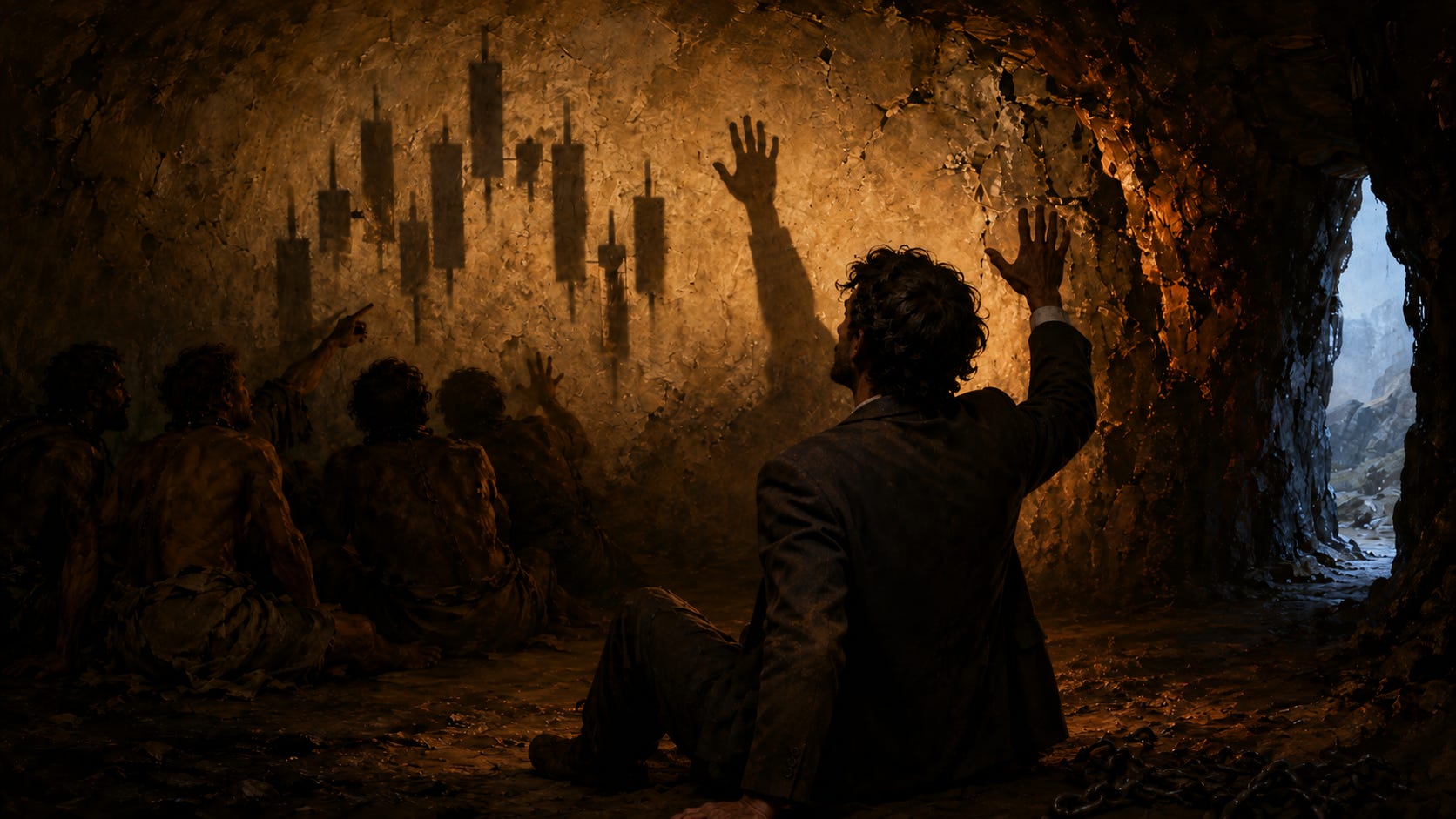
Plato’s Cave has been a central theme for Reading the Tape since my inaugural article, The Evolution of a Tape Reader: On Learning to See What’s What. The Inquisitor’s guest post yesterday reinvoked it. I mentioned before this was one reason I was so excited by his article: this article was already being written and I already had Plato’s Cave baked in with my title.
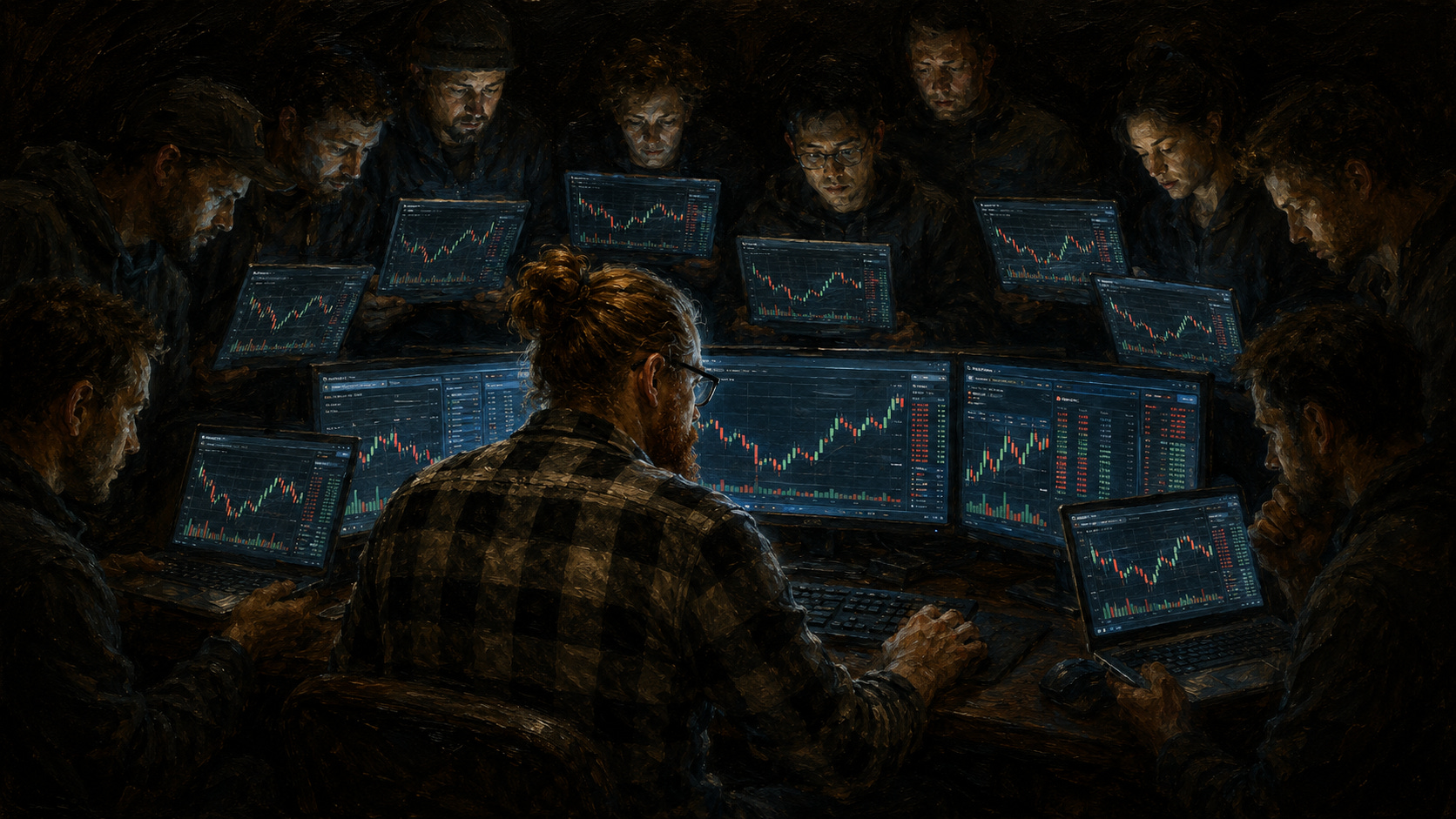
But the version of Plato’s Cave that I was thinking of is different. It’s the Chat Room where Ross and his congregants congregate. Ross sits near the fire — his Five Pillars — and I could make an argument that even though he does, he doesn’t fully understand the shadows on the cave’s wall. Maybe he doesn’t understand, as the one closest to the fire, his part in the creation of those shadows and how the influence they will have on his congregants inures to his own benefit. But he does understand the shadows better than his student “traders” confabulating their education while arguing over the meaning of the shadows, and who mostly only recognize Ross’s shadow as it moves across the wall, mostly just follow it.
This last piece is the reflexivity being reflected in the shadows on the cave wall.
Most of those “traders” are chained in place by their own inability to gain real understanding. They think they know what the shadows are.
“There’s a dragonfly doji!”
“No, the tail’s not long enough and the real body is too fat: it’s a hammer!”
A number of these shadow watchers will not even begin to recognize a micro pullback or a Concealing Baby Swallow.
But they will always recognize Ross.
This sounds pretty bleak. But it fits both Lance’s argument that the reflexivity of Plato’s Chat Room (my term, by the way; not his) may account for some of Ross’s success and Ross’s constant reminder that his own results are atypical.
There is an exit from the cave. There is a path to profitability. There are those who get out of their shackles, stand up, turn and see Ross, the fire, and the sunlight beyond the entrance. These are the ones who will have done what Ross — and Aziz, and Grimes, and so many others going back to Livermore — teach.
They don’t argue as much as the others over the shadows. They simply watch. They listen to Ross. They probably also read Aziz, Grimes, Livermore, and others. They perform their own experiments: they raise their arms in the air and notice that they, too, create shadows. The fire flickers and they begin to see directionality. The light intensifies and they recognize volume.
That’s when they turn. That’s when they see the exit that gives them a path to their own success. No longer bound by shadows they do not understand.
Because they have internalized the system. Then transformed it. Then seen that there is even more outside the cave to learn about.
Some might stay. After all, they’ve formed friendships in the cave, not least of which with Ross. They may become co-trainers in the system. But they will each have their own deep understanding of the shadows.
And speaking of co-trainers, before we close, we can’t forget our old friend, Lance. Lance led me to seeing more of what was going on with Plato’s Chat Room. And although Lance visited that cave, it was just a visit: he initially viewed and later critiqued it from his own. Because, you see, Lance is a trader-trainer, too.
I’m Lance and after making over a hundred million dollars trading on Wall Street, I’m done trading my health for wealth. And now I feel that it’s my responsibility to be the voice of reason in the trading education space full of fake gurus promising you fast profits.
— Lance Breitstein, Reacting to Ross Cameron’s Momentum Trading Strategy (Is He Legit?) (April 18, 2026)
Hey. Everybody’s gotta make a buck.
If Reading the Tape has been worth the time, you can drop a coffee in the tip jar. It buys the next pattern I'm trying to learn, and occasionally an actual coffee.
Livermore’s Tape
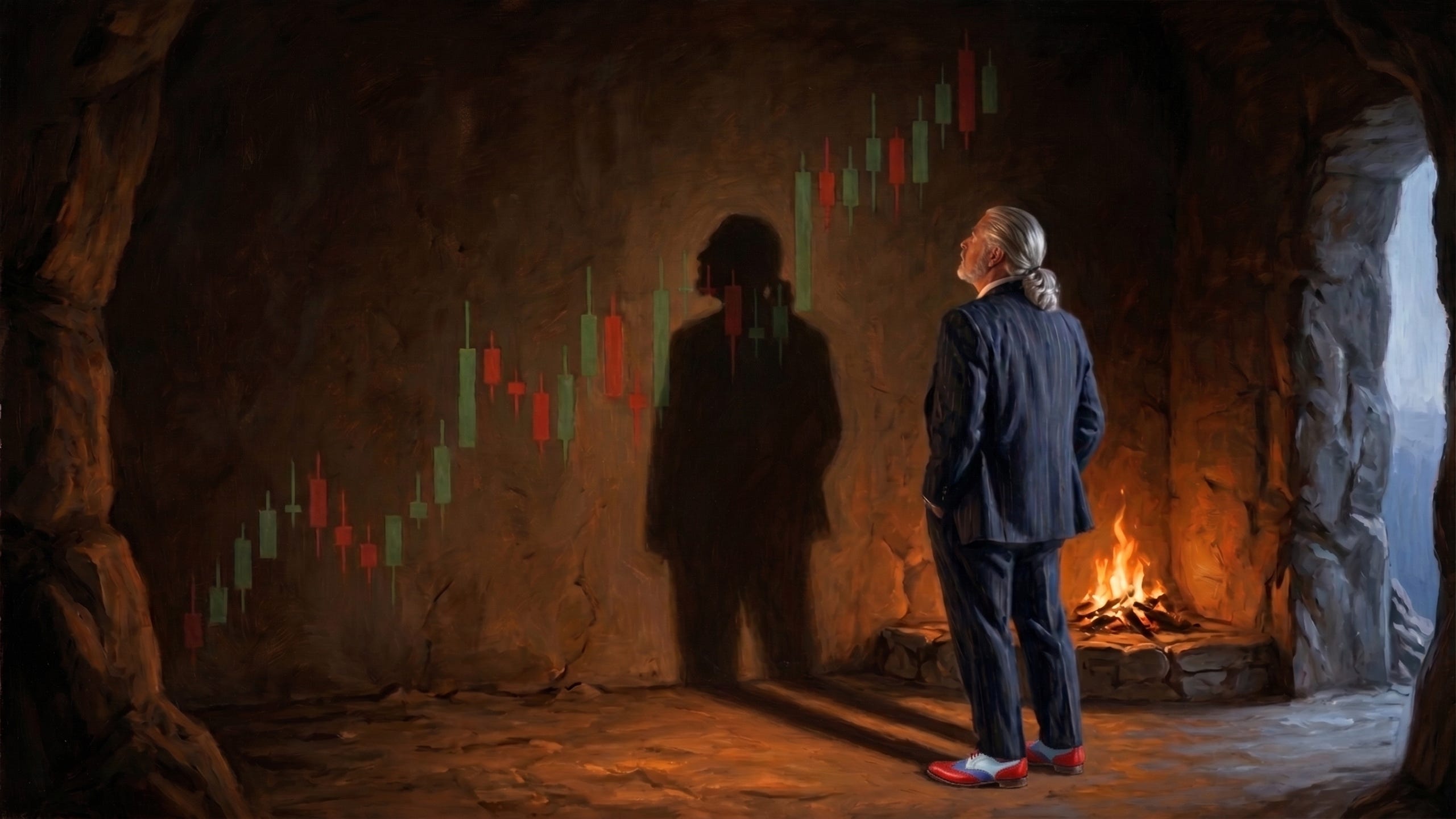
So I’ve shown you that there’s more than one cave here. Plato’s Chat Room is one. The Inquisitor’s Casino is another.
There are more.
What they all have in common is that they’re all about reading shadows. Reading the Tape. Spotting patterns. For both the Chat Room and the Casino, they’re about reflexivity. They’re both about what happens to a tape reader when the tape they’re reading is partly being written by the architecture they’re inside of.
The Chat Room and the Casino arrived at the same allegory through different cave mouths. The Inquisitor came through the mouth of the Consumer’s Cave and I came in through the Trader’s.
The edge that made Livermore extraordinary has been closed permanently, and from the other direction, and on every human being simultaneously.
— The Harlequin Inquisitor, The Ghost in the Machine is Reading Your Tells: On the Epistemology of Being Badly Profiled, and Why You Should Be Worried Even If the Algorithm Is Wrong (May 10, 2026)
The Inquisitor showed Livermore’s edge closed from above. Algorithmic latency read the inputs before the consumer recognizes them as preferences. Casting Shadows has shown the edge corrupted from below. Audience amplification turned the leader of Plato’s Chat Room into a tape-mover whose entries appear earlier than their underlying read justifies. So we get two structural assaults on the same Livermore who staked his identity on being first. From the surveillance side, no one is early to anything anymore. From the chat-room side, the one who appears to be early is being made early by the people watching him be early.
But Livermore’s discipline isn’t foreclosed. It’s just lonelier. The clean tape Livermore worked from no longer exists in the modern microstructure, but the discipline of reading what is rather than what should be still applies.
It just costs more now.
The reader who recognizes they’re partly writing the tape they’re reading is the only kind of reader who can read it honestly. Anyone else is in the cave, arguing about shadows.
I opened Casting Shadows by talking about my own experience in Plato’s Chat Room. I mentioned that I got access to the tools, but didn’t get as much of a chance to watch Ross in action. I said this was probably a huge plus. I didn’t have the chance to simply follow. And during that same time period, I was reading or had read Aziz, Grimes, Nison, Soros, Morris, Carter, Livermore, and others. I was putting in the work.
Because I’m a part-time trader — my day job is being a criminal defense lawyer with my own solo practice — I walked out of the cave at the end of the two-week trial (extended to three through the courtesy of Warrior Trading because I barely got to see Ross trade). And while I miss the tools (10-second charts are heaven), I’m glad to be out of the cave, finding my own way. For a part-timer, I’m not doing badly. I’m usually more green than red. I’m nowhere near Ross’s level, but I’ve made some thousands since I started in November 2025.
I’ve started building my own cave. There’s no one in it except me and the millions of shadow-casters — it’s more accurate to call them candlestick makers — from around the world. I have my own fire. And sometimes I raise my hand to see what shadows might form.
Because before there was an algorithm above him or a chat room below him, I’d already learned from Livermore the importance of recognizing that the read is also always a write.
And the only honest reader is the one who knows the difference.