

The Tape Doesn’t Lie — It Never Did
[T]he best of all tipsters, the most persuasive of all salesmen, is the tape.
— Edwin Lefèvre, Reminiscences of a Stock Operator 335 (Jon D. Markman annotated ed., John Wiley & Sons 2010)
The core premise of Reading the Tape is pattern recognition applied to real data. Not imagined data. Not hoped for data. It’s not anything speculative at all. Rather than listening to what someone says, you read the tape.
The extension of this premise is that anything can be the tape. That was the rationale behind creating this Substack. I didn’t want to dilute my first Substack, Probable Cause, with non-criminal-defense-related posts. Reading the Tape was a natural move to achieve my goal because I was already using the metaphor when discussing criminal law issues.
Today we’re reading the tape on a man whose tape has been consistently printing the same pattern for at least forty years. There’s nothing hidden. Nothing ambiguous. Somehow, at least it seems to me, it has been consistently ignored by people who preferred the narrative to the data.
Not everyone can read tapes and my intent in reading this tape is about pattern recognition; not politics.
The Good — Giving the Devil His Due
Intellectual honesty requires acknowledging what the man actually does quite well. Brand creation. Narrative salesmanship. Getting sophisticated people — banks, investors, voters — to extend credit on the basis of a story rather than fundamentals.
George Soros, in his book The Alchemy of Finance, introduced the theory of reflexivity. When people believe something about the market, they act on that belief, and those actions actually change the market — so the belief partly creates the reality it was trying to predict. It’s like during the pandemic when everyone believed for some odd reason that stores would run out of toilet paper. So people rushed to buy it all — I saw people wheeling two grocery carts stacked above and below with large containers of toilet paper — and then the store actually did run out. The belief made itself true.
Underlying Soros’s reflexivity theory (if you can really call it a theory) is the Human Uncertainty Principle. Sounds like the Heisenberg Uncertainty Principle, right? But
Heisenberg’s uncertainty principle does not influence the behavior of quantum particles one iota; they would behave the same way if the principle had never been discovered. The same is not true of the human uncertainty principle. Theories about human behavior can and do influence human behavior.
— George Soros, The Alchemy of Finance 7 (2d ed. 2015)
I seriously doubt Trump has the neuronal capacity to actually understand reflexivity or anything else George Soros might say. But he somehow appears to have developed one great skill related to it to the utmost: his self-mythology fed back into reality. People believed the brand, which made the brand real enough to borrow against, which funded the next venture, which reinforced the brand.
But the reality is that Trump is a genuinely talented liquidator who convinced everyone they were hiring a builder. I mean, come on, name one other person in the history of the world who could sell Trump steaks (until he couldn’t) AND got elected President failed to get re-elected (until he did) AND launched a crypto coin (which has lost 96% from its highest value reached two days after it was launched).
The salesmanship is real. It’s just entirely decoupled from the underlying product.
The Bad — The Business Autopsy
In November 1987, Donald Trump published The Art of the Deal — a book that would sell millions of copies and cement his reputation as America’s premier businessman. It was ghostwritten by Tony Schwartz, who has since said publicly that he deeply regrets it and that the version of Trump he created was largely his own invention. Schwartz coined a phrase in the book to describe Trump’s promotional style: “truthful hyperbole.” It is, on reflection, the most honest sentence in the entire volume. It is an oxymoron that accurately describes a con.
What almost nobody noticed at the time was the tape that was already printing underneath the mythology. Trump Plaza Hotel had opened in 1984, three years before the book dropped. The Taj Mahal casino — the one that would become his most spectacular bankruptcy — was already in motion. The Trump Shuttle airline would be purchased the following year. The book that supposedly explained his genius as a dealmaker was published in the middle of the wreckage, not before it. He was selling the prospectus while the enterprise was already failing.
The Art of the Deal is, in retrospect, not a business book. It is a liquidation manual dressed as a success story. The core move of the book is consistently the same: leverage narrative to extract capital, use other people’s money to fund the brand, and make sure the story is always bigger than the underlying asset. There is no framework for creating value. There is only a framework for appearing to create value long enough to borrow against it. Trump presents this all as genius.
The deals that followed confirmed what the tape had been saying all along.
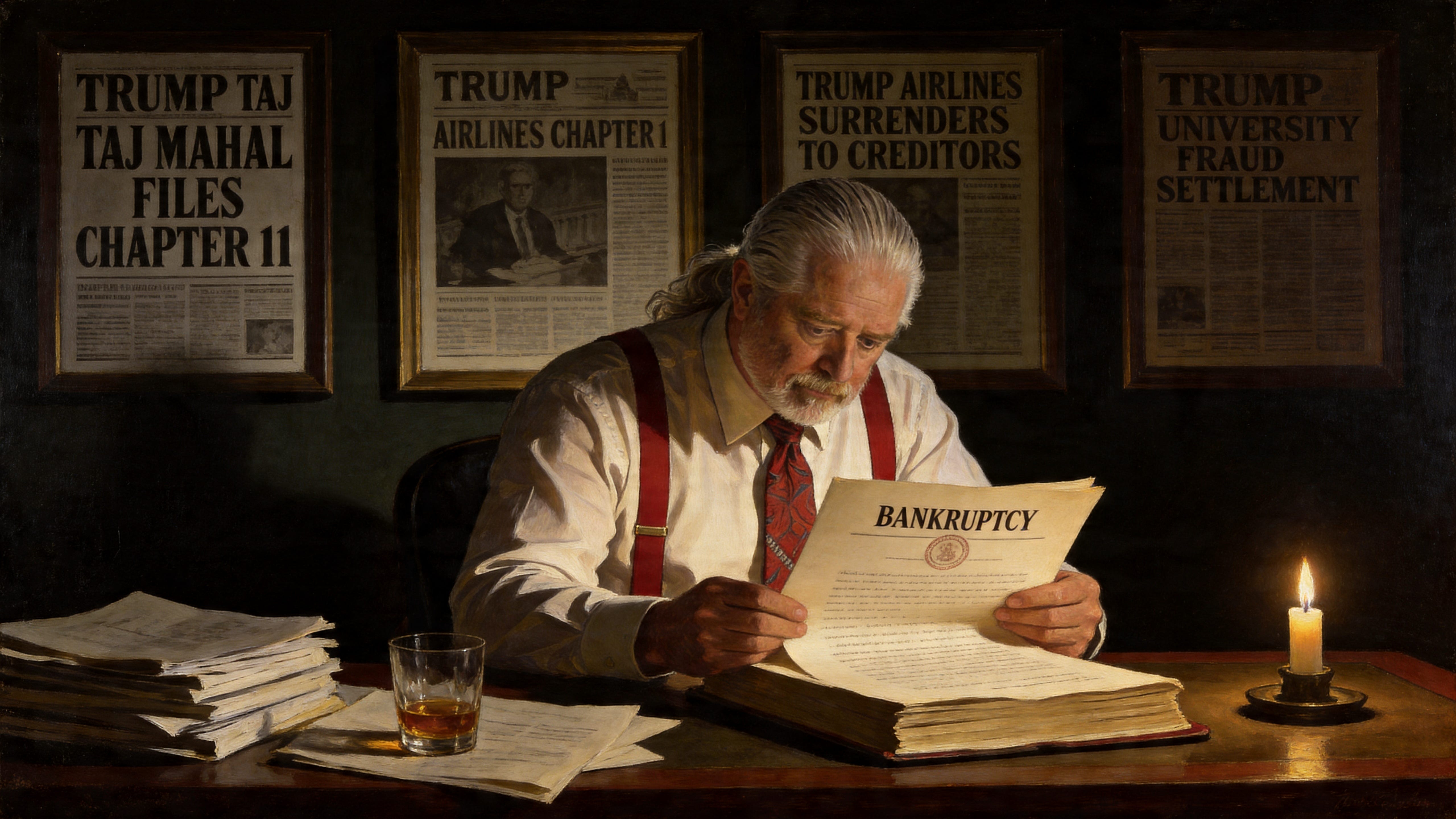
Casinos: Trump’s Atlantic City properties (the Taj Mahal, Trump Plaza, Trump Castle) filed for bankruptcy multiple times between 1991 and 2009. Bondholders were wiped. Contractors went unpaid. Employees lost jobs. Trump himself, through a combination of debt restructuring and equity dilution, managed to reduce his personal exposure while others absorbed the losses. The mechanism involved extracting the licensing fees and management income while ensuring the debt sits on someone else’s balance sheet.
Then there was Trump Airlines. Purchased in 1988 for $365 million, just one year after The Art of the Deal told the world what a genius he was, the shuttle service never turned a profit. He defaulted on the loan, surrendered the airline to creditors in 1992, and walked away. The mechanism this time? Borrow against the brand, collect the prestige, leave the debt for the lenders.
Trump Mortgage is the next new kid on the block about to hit the block. Launched in 2006 with Trump declaring on CNBC that it was “a great time to start a mortgage company” and that “the real estate market is going to be very strong for a long time to come.” It closed eighteen months later as the housing market collapsed around it. The mechanism will sound familiar: license the name, collect the fees, bear none of the actual risk.
Trump University operated from 2005 to 2010, charging students up to $35,000 for real estate seminars that delivered essentially nothing of what was promised. New York Attorney General Eric Schneiderman called it a “straight up fraud.” Trump settled for $25 million in 2016 — without admitting wrongdoing, naturally. By now, you should start seeing a pattern. The mechanism that drove it was to sell access to the myth, collect the tuition, leave the students holding worthless certificates and empty bank accounts.
One of my favorites was Trump Steaks. Two months. $50,000 in total sales, if that, according to the Sharper Image CEO who ran the licensing deal. Trump put in nothing — no minimums in the contract, no financial exposure, no risk. Again, the mechanism was to license the name, let someone else absorb the loss, move on.
And if you can’t sell steaks? Maybe you should move on.
And, finally, the USFL where Trump purchased the New Jersey Generals in 1983 and promptly lobbied to move the league’s games from spring to fall, where it would compete directly with the NFL. The strategy was widely understood to be an attempt to force a merger — or an antitrust lawsuit that would pay out damages. The league folded in 1986. The antitrust suit succeeded in court but the jury awarded damages of exactly one dollar, tripled under antitrust law to three dollars. The familiar mechanism you should be able to recite by heart. In this case, it was to use other people’s franchises as leverage for a personal play, exit when the play fails.
This is where Thomas Kuhn becomes useful. Kuhn observed that paradigm shifts don’t announce themselves — they accumulate at the margins as anomalies the existing framework keeps trying to explain away. Each collapse in Trump’s business record was treated as exactly that: an anomaly. A bad market. Overly aggressive lenders. Jealous competitors. Biased media. The framework of Trump as genius businessman kept absorbing the contradictions because the people most invested in the myth were always the last to update.
The tape, however, was printing the same thing every time. It wasn’t failure. Failure happens to everyone. What tied everything together was the mechanism. In every single case, Trump extracted value for himself while the enterprise collapsed around him. Contractors stiffed. Bondholders wiped. Students defrauded. Banks left holding paper. Shareholders diluted. The pattern is too consistent to be accident. It is the business model.
The Art of the Deal didn’t foreshadow this accidentally. It described it explicitly, in plain language, and called it genius. The readers who made it a bestseller weren’t misled. They just didn’t know how to read the tape.
The Very Ugly Truth — Same Play, Bigger Stage
Because the majority of Americans are not very good tape readers — in fact, many don’t even understand there is a tape they could read, apparently — Trump is now running the identical mechanism on the United States and the Western order. Same skill set. Same extraction pattern. But, man, are we on a wholly different scale.
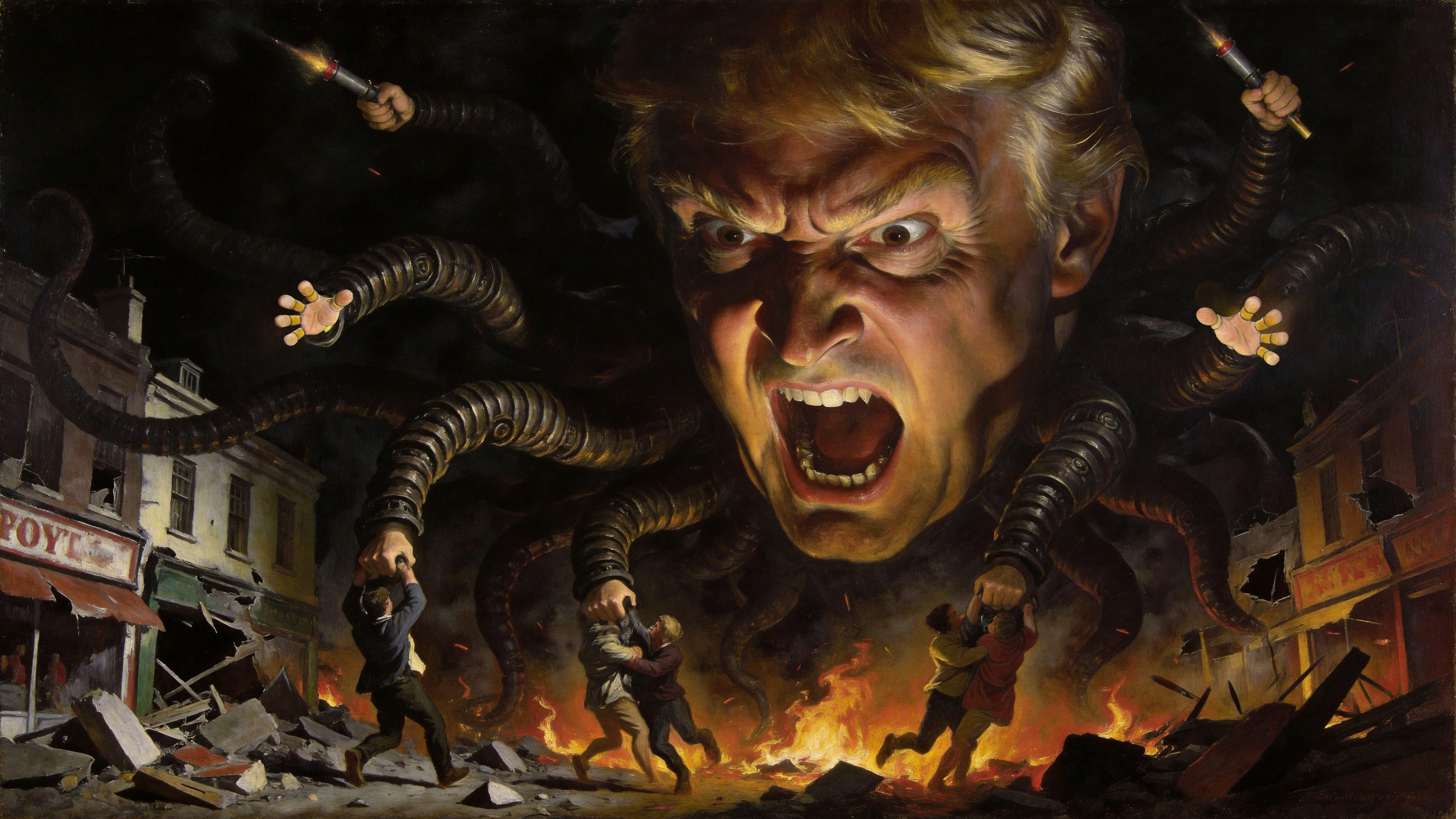
I’m not even going to get deep into the grift here. Grift has always been part of his game. His use of power to obtain emoluments including $400 million jets, multi-million dollar “donations” (a.k.a. bribes) from corporations (which didn’t work), pardons for purchase (which also cheated victims, again), and other grifts allegedly bringing in billions. Nor do we need to speak much about the $1.25 billion he essentially allegedly pilfered from the State Department by having transferred to his bogus “Board of Peace”, created just before he started the war on Iran that is where the tape has begun printing the real liquidation of U.S. assets.
This all constitutes one-half of the tape we’ve already seen on Trump. The part where he takes from the company he’s about to liquidate.
The second-half is the most damaging to the United States. Eighty years of work, all headed for liquidation. Trump went into his new term rattling the world stage by talking about taking Greenland. (And Iran has only intensified that threat.) Canada, he said, should be our 51st state. Then he went after Venezuela, sweeping in with the U.S. military and kidnapping their President — after having spent weeks killing their fishermen under claims they were running drugs that were killing U.S. citizens — and, when he was finished with that, salivating over the U.S. taking their oil.
And then, of course, there is the constant alienation of allies. Talk about your Art of the Deal. The same allies who have helped the United States maintain some semblance of world order over the last 80 years.
Soros’s insight was that in human systems, perception and reality are not separate. They interact. Belief shapes behavior, behavior shapes outcomes, and outcomes reshape belief — in a continuous loop that can run in either direction. Markets can inflate beyond any rational basis because enough people believe they will, and their belief makes it so, until the moment it doesn’t. The same mechanism runs in reverse. Once enough people believe a system is unreliable, they act as if it is unreliable, and their actions make it so.
Which doesn’t absolve Trump from blame. He is, after all, the catalyst for the current shift.
This is the reflexivity argument at full power — and it is not a metaphor for what is happening to American institutional credibility. It is the actual mechanism.
Consider what American institutional reliability actually was, structurally. It was not merely a reputation. It was load-bearing infrastructure. The entire post-war global order — NATO, the dollar as reserve currency, freedom of navigation, the nuclear umbrella, the credibility of American treaty commitments — was built on a single foundational assumption: that the United States means what it says. Allies made defense decisions based on it. Central banks held dollars because of it. Supply chains were organized around it. Shipping lanes stayed open because of it. The belief was not incidental to the system. The belief was the system.
That belief was already under strain before Trump was re-elected. But, as with all good liquidators, it’s that already stressed “asset” — U.S. credibility — that he’s hit the hardest.
When you begin liquidating that credibility, you are not merely damaging a reputation that can later be repaired with better public relations. You are triggering a reflexive process that accelerates itself. (This is part of Soros’s reflexivity insight.)
Here is how the loop runs:
An ally observes that American commitments are no longer reliable. The rational response is to hedge — to develop independent capabilities, to diversify relationships, to stop making long-term plans that depend on Washington. That hedging is itself a signal, visible to other allies and to adversaries.
This is not speculation. It is what the tape is printing right now.
And there is a reason this is happening now rather than in 1975 or 1955. Institutional memory is generational. The people who built the post-war order built it with living memory of what happens when it doesn’t exist. Eighty years later, that memory is gone. What remains is habit without understanding, rules without the visceral knowledge of why the rules exist. That is a different kind of vulnerability than mere political disagreement. It’s structural. And a talented liquidator can feel structural vulnerability the way a good card player feels the table.
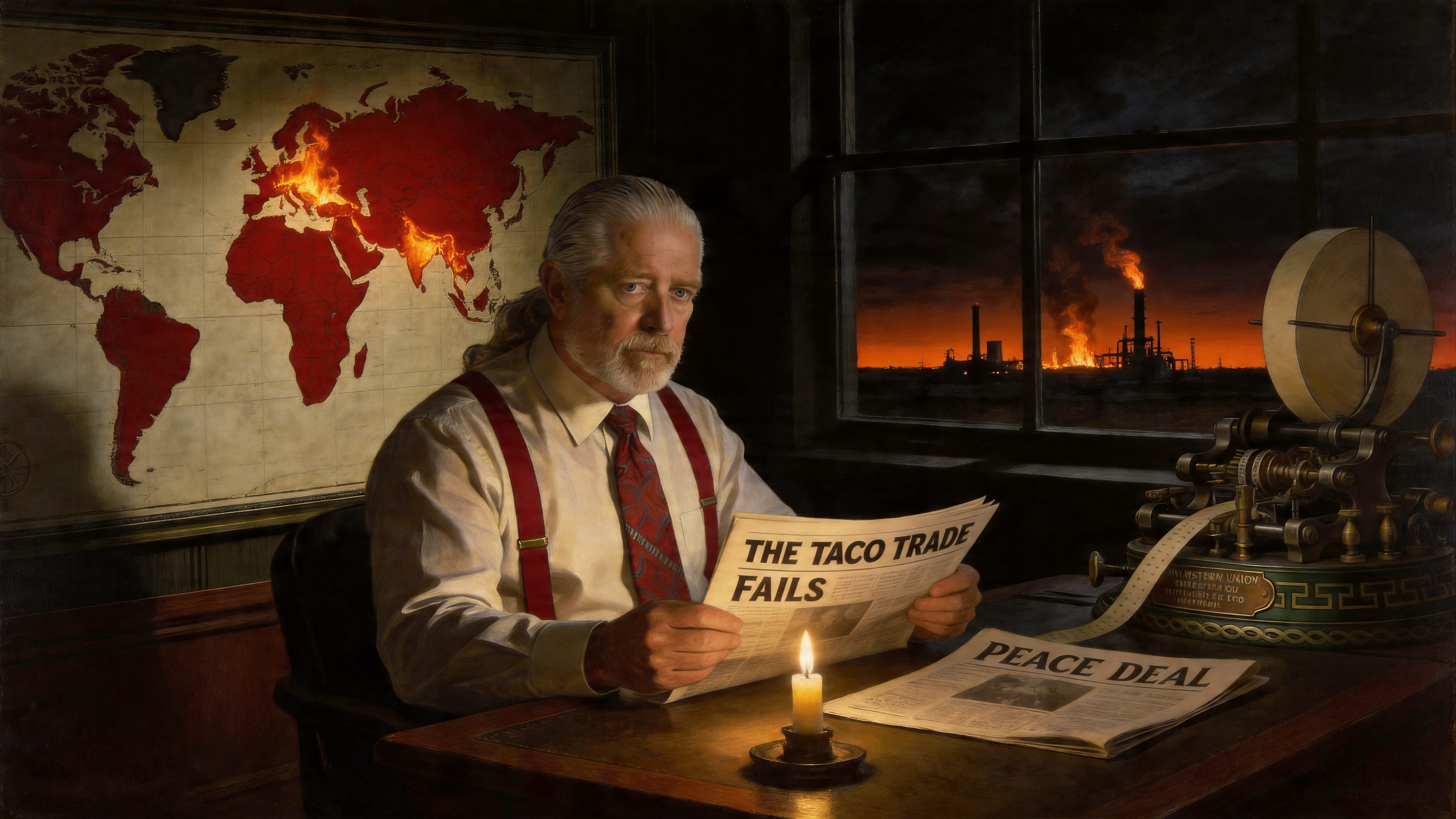
The Strait of Hormuz is functionally closed — a forty-year assumption of American naval supremacy over the world’s most critical energy chokepoint, broken. Though its actual status is less clear and seems to change by the hour.
The Trump Tape prints what it always has: everyone but Trump himself (so far) is taking the hit.
Our closest allies are organizing frameworks for freedom of navigation that do not include us. They are not doing this to punish us. They are doing it because the rational response to an unreliable partner is to stop depending on that partner. Meanwhile Moscow is selling oil at a premium to energy-starved buyers while we absorb the geopolitical and economic cost of a war whose principal beneficiary wears no American uniform. Consumer confidence has hit record lows — not because Americans have carefully analyzed geopolitical theory, but because they can feel the instability even if they cannot name it. The feedback loop does not require sophistication to transmit. It only requires consequences.
The Kuhn dimension here is worth pausing on. Paradigm shifts, Kuhn observed, do not feel like paradigm shifts from inside the paradigm. They feel like a series of manageable anomalies, each of which gets explained away, until the weight of the unexplained becomes too great and the model collapses. The people most invested in the old paradigm — the ones whose identity and worldview depend on it — are reliably the last to see it. From inside the American exceptionalism paradigm, each of these events looks like a temporary disruption. The Hormuz situation will resolve. The allies will come back. The markets will stabilize. The president will pivot.
The tape does not share that optimism. The tape is printing what is actually happening — not what we hope will happen, not what spokespeople say is happening, not what cable news is arguing about. And what is actually happening is that the load-bearing belief is being liquidated, at scale, by someone who has spent forty years perfecting exactly this mechanism.
In markets, we have a name for an asset whose value depends entirely on the continued belief that it has value. We call it a confidence game. The moment enough participants update their model, the asset reprices — not gradually, but all at once, because everyone is watching everyone else watch everyone else.
American credibility is not a confidence game. It is — or was — something real, built over decades through consistency, sacrifice, and institutional reliability. But it can be treated as a confidence game by someone who understands, instinctively or otherwise, that perception and reality are not separate. That once you control the narrative long enough, you can borrow against it. That by the time the creditors figure out what happened, you will have already moved on.
The liquidator always moves on.
Reading the Intent vs. Reading the Tape
As I wrote in a recent Note, with each passing day it becomes harder not to see Trump as the greatest Russian asset in history for undermining the United States — and I was precise about what I meant. I was not making a legal argument. I was making a pattern recognition argument.
The distinction matters.
When I wrote about the suspicious pre-announcement trading in the hours before Trump posted his Iran ceasefire announcement on Truth Social — volume spikes in S&P e-Mini futures and oil contracts that only made sense if someone already knew what the announcement would say — I didn’t need to know who placed those orders to read what they meant. The tape printed what it printed. Intent is for lawyers. Behavior is for traders.
The same lens applies here. Whether the damage to Western institutions is by design, by affinity, or by the simple chaos of a personality that mistakes domination for strength — the tape reads the same either way. Russia spent the better part of a century trying to accomplish what one election cycle has. You don’t have to read the intent to read the tape.
The Losing Trade
In markets, we have a word for a position that keeps moving against you while you construct increasingly elaborate reasons the thesis is still intact.
We call it a losing trade.
The reasons accumulate. The market doesn’t understand yet. The fundamentals will reassert themselves. The catalyst is coming. Smart money is accumulating. This is just noise.
Meanwhile, the position bleeds.
Every trader knows this feeling. The refusal to update. The sunk cost masquerading as conviction. The story you keep telling yourself because the alternative — that you were wrong, that the tape was right all along, that you held through the damage because you couldn’t face what the prints were saying — is too uncomfortable to sit with.
The question worth sitting with — while oil trades above $100 and our allies hold their own meetings without us and the dollar loses its automatic safe-haven status — is who exactly is holding that position.
Who’s long on American credibility at current prices, constructing reasons why this resolves.
And who’s on the other side.
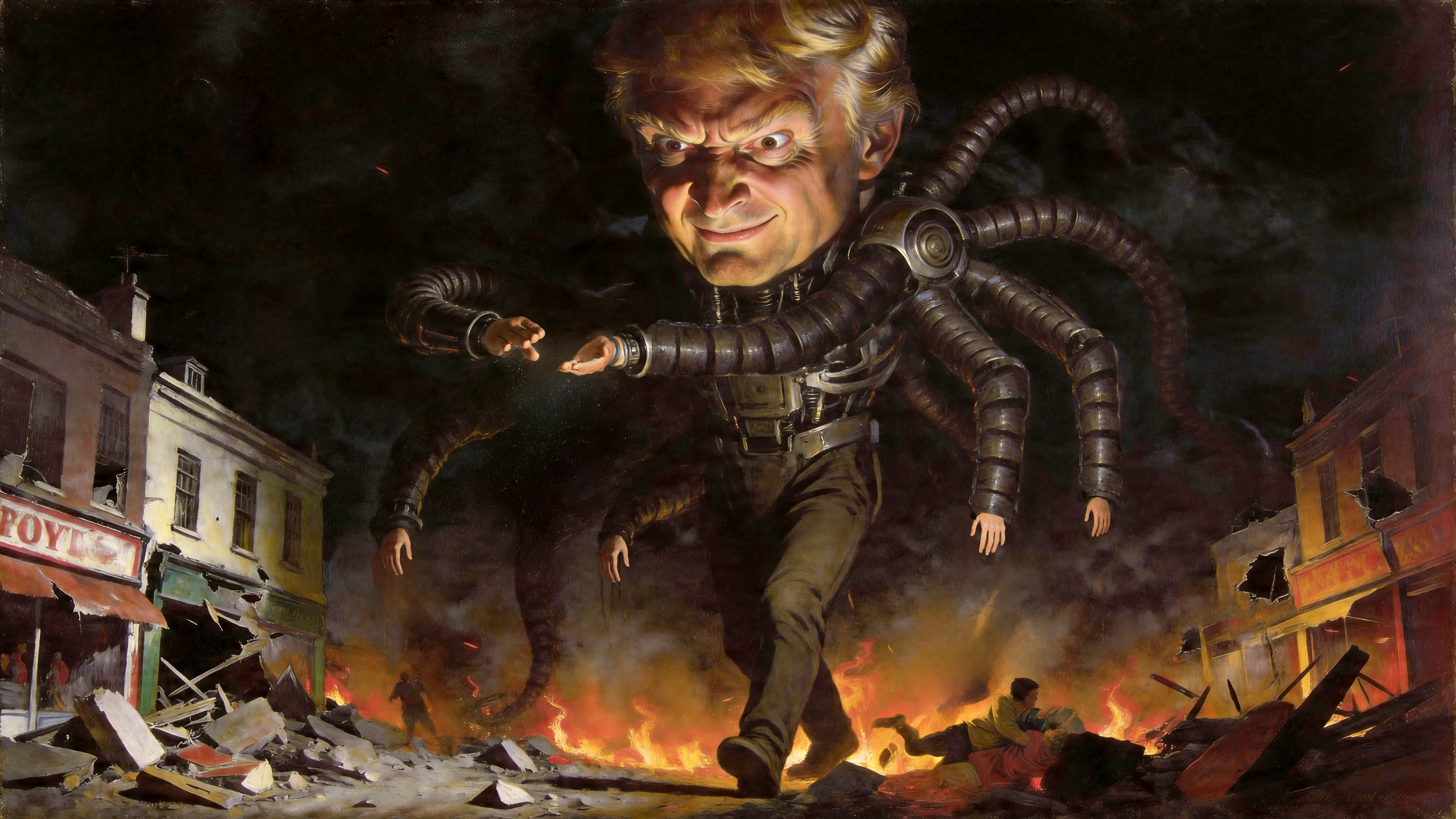
The liquidator always moves on. He has already moved on from the casinos. From the airline. From the mortgage company. From the university. From the steaks. From the crypto coin.
The question is never whether he moves on.
The question is what he leaves behind.
The tape doesn’t lie. It never did.
If you want to support my writing so I can do more of it,
please consider buying me a coffee and subscribing!