

A Guest Post by The Harlequin Inquisitor who makes regular appearances on Bard-at-Arms
Your host told you something important in “The Traded Self.”
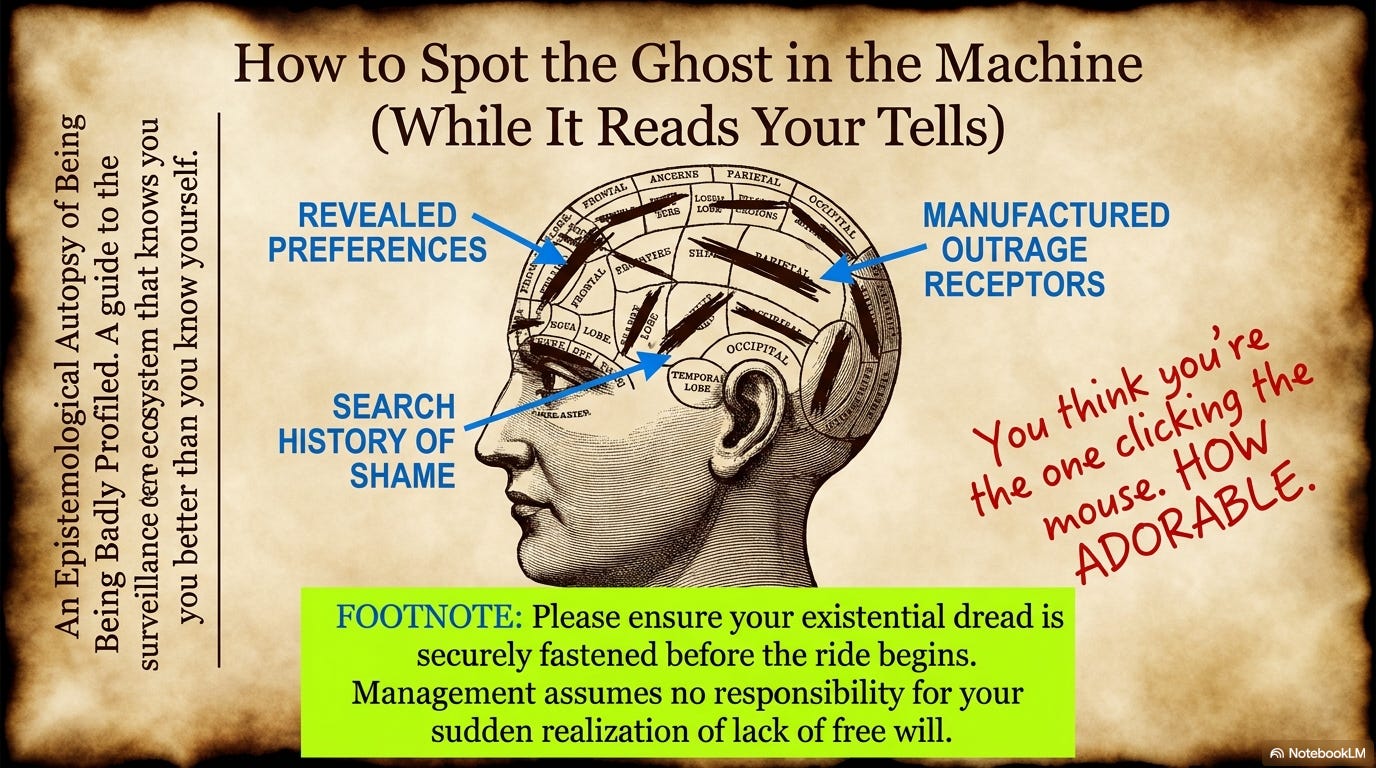
He told you the tape is reading you. That every click, pause, channel change, and midnight impulse has been priced by marketers before you’re even conscious of having the impulse. That ACR (Automatic Content Recognition, or as I prefer, the Dossier of Everything You Are Too Embarrassed to Admit You Watched) has assembled a caricature of your revealed preferences and is selling that caricature to the highest bidder.
He’s right.
He told you the danger isn’t that the Mothership knows you perfectly.
He’s also right about that.
But here’s the part he stopped just short of, the part I cannot let pass without surgical intervention, because it is the part that keeps me up at night in the finest tradition of people who think too hard about epistemology:
What if you’re performing for the tape?
The Measurement Changes the Measured
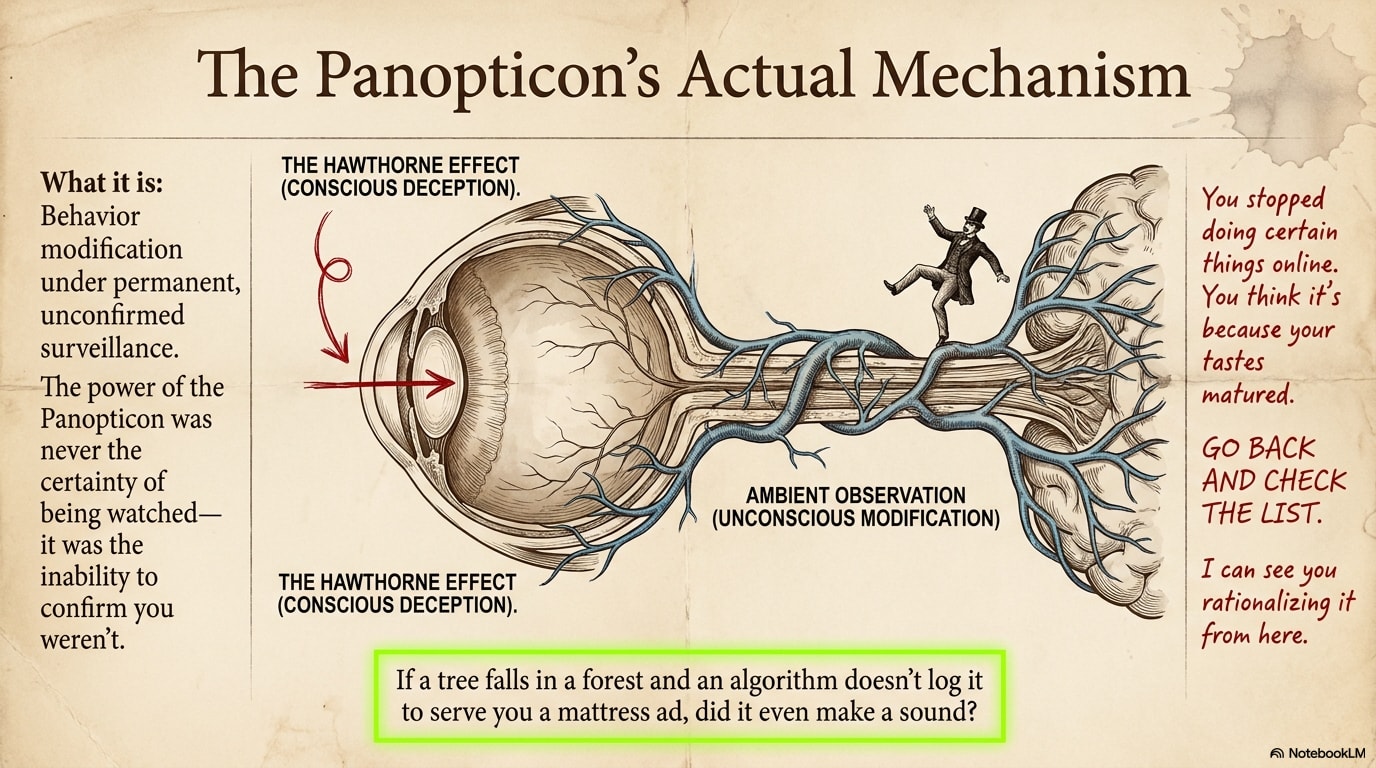
There’s a principle in social science called the Hawthorne Effect. Put a person under observation and they modify their behavior. Not necessarily consciously. Not because they’re being deceptive. Simply because the act of being watched restructures what being yourself means in that moment.
But the Hawthorne Effect describes behavior change under known observation. The worker who knows the researcher is watching, the student who knows the camera is on. What the surveillance ecosystem produces is something more insidious and more interesting: behavior change under ambient observation, where the subject half-knows and half-forgets they are being watched. The possibility of observation is permanent. The certainty of it is never quite confirmed. This is not Hawthorne. This is the Panopticon’s actual mechanism, and the Panopticon’s power was never that the warden was always watching. It was that the prisoner could never confirm the warden wasn’t. The behavioral modification runs deeper precisely because it operates below the threshold of conscious calculation. You are not deciding to perform. You have simply stopped doing certain things, and the absence feels like preference.
Now. Your host explained George Soros’s theory of reflexivity: the feedback loop in which participants’ beliefs about a market become a force within that market, altering the very thing being observed. He applied it to the ACR surveillance complex rather brilliantly. The Mothership is reading your psychology and feeding predictions back at you in the form of targeted ads, algorithmically curated content, bespoke shadows on Plato’s cave wall.
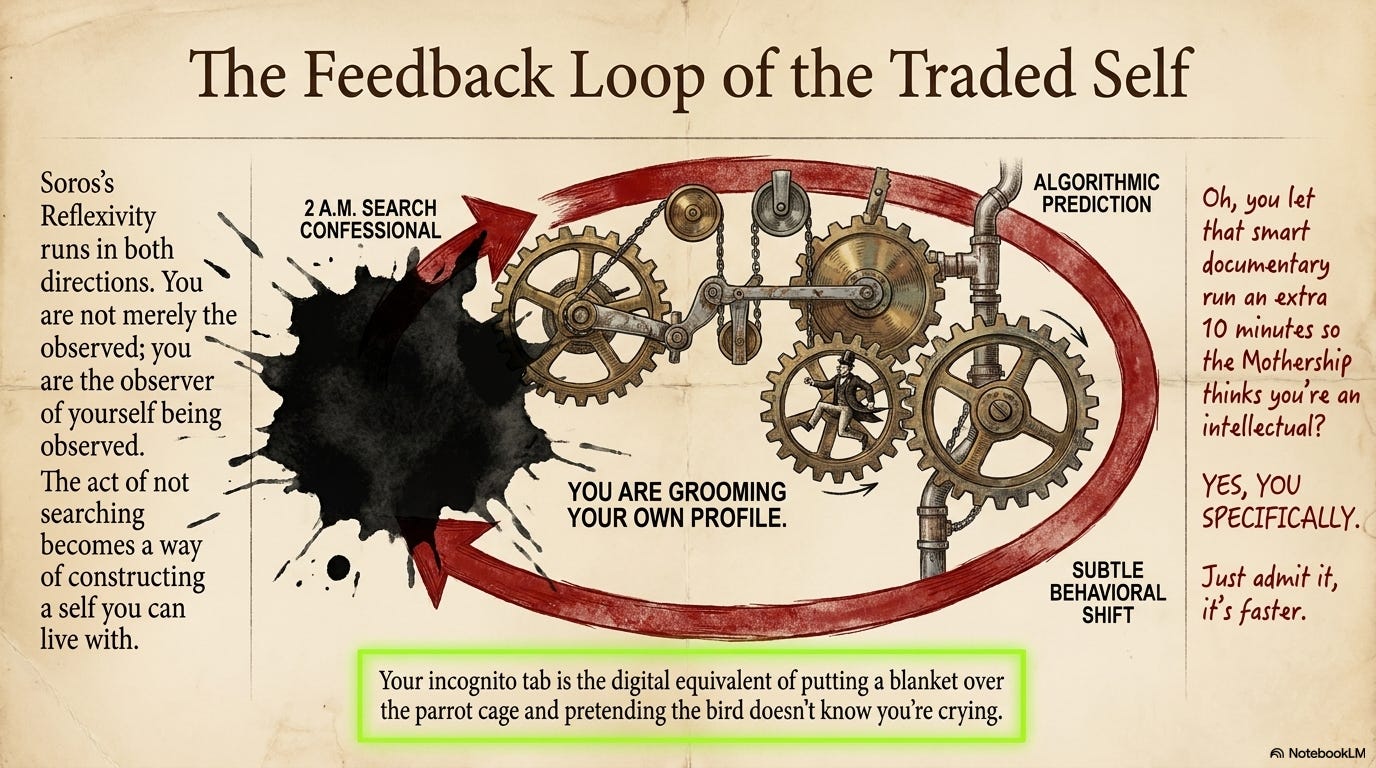
But Soros’s loop runs in both directions. You aren’t merely the observed. You are also, over time, the observer of yourself being observed.
And this is where it gets interesting. And by interesting I mean quietly catastrophic.
You know the algorithm is watching. You’ve known for years, in the way one knows things one would prefer not to examine too directly. You know that your 2 a.m. search history is a confessional you never intended to give.
And so you adjust. Slightly. Below the level of deliberate decision. You click things you feel you should click. You let certain videos run longer than you want to, because stopping them too early feels like a verdict. You avoid searching for things you’re ashamed to want to know, because the act of not searching has become a way of constructing a self you can live with.
You are grooming your own profile.
The Bad News About Being Badly Read
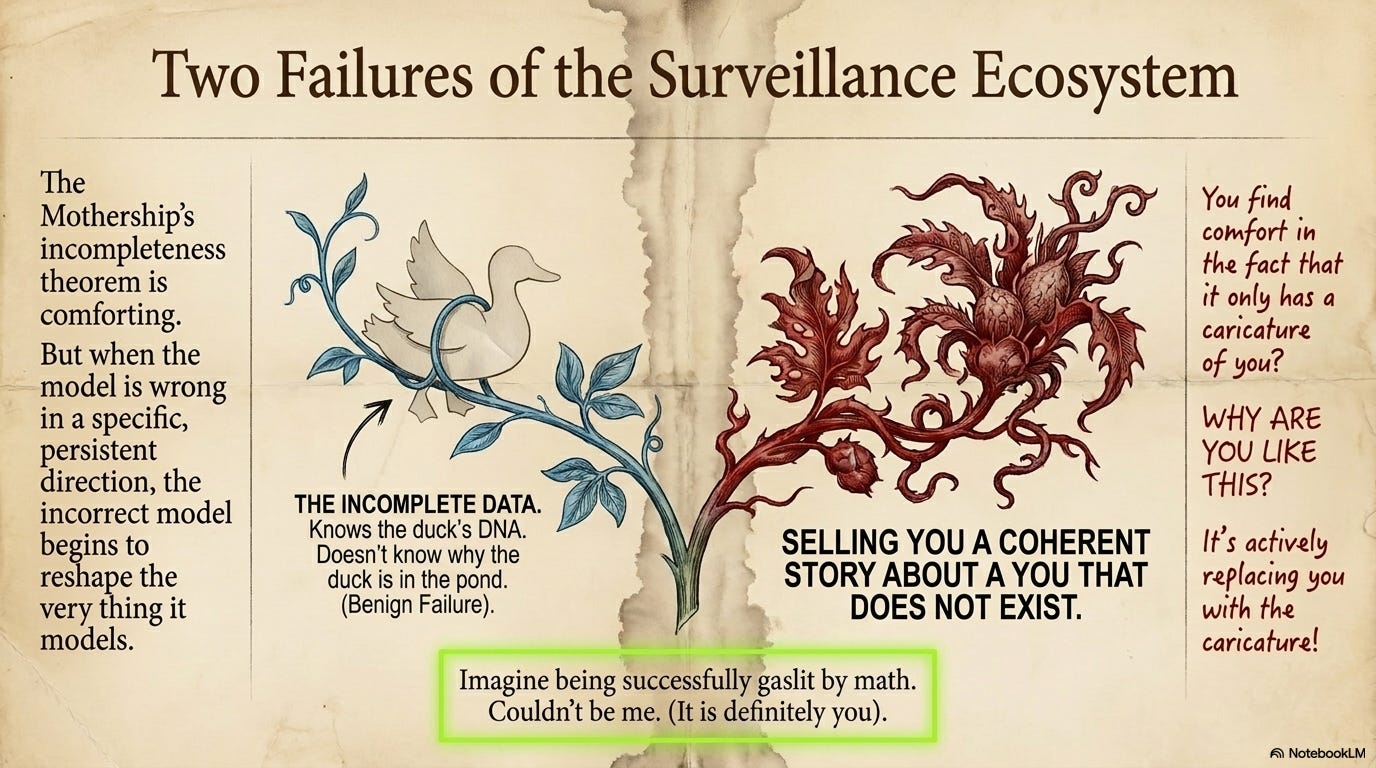
Your host, with admirable intellectual honesty, acknowledged the Mothership’s incompleteness theorem. The profile it builds is a high-resolution caricature. It sees the transaction but cannot see the intent. It knows the duck’s DNA but not why the duck is in the pond.
This is comforting. It should not be as comforting as you are currently making it.
Because there are two ways to be badly read.
The first is the version your host described. The Mothership has incomplete data. It has your clicks but not your consciousness. It has your revealed preferences but not your reasons. It has mapped the coastline but not the interior. This is the benign failure of surveillance: it knows you are approximately a duck but cannot tell you anything meaningful about duckness.
The second failure is quite interesting and considerably more dangerous.
The second failure is when the Mothership’s reading of you is wrong in a specific direction. Not incomplete. Not merely imprecise. Wrong in a way that tells a coherent, internally consistent story about a version of you that does not quite exist... and then sells that story back to you with such confidence and repetition that you start to wonder if perhaps it is the one who knows.
This is what Soros means by the feedback loop becoming self-fulfilling. The incorrect model, presented authoritatively and persistently, begins to reshape the thing it models.
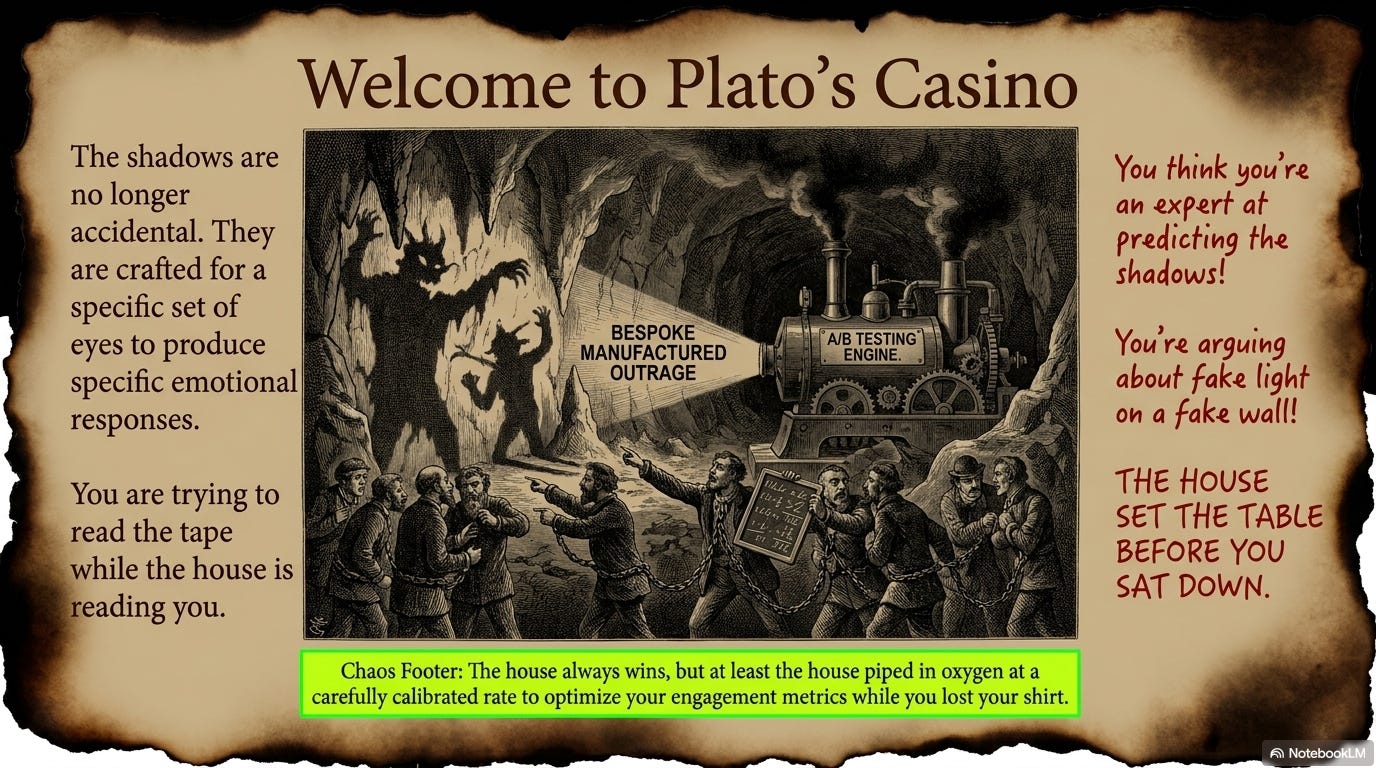
Here is where Plato earns his square footage. The shadows on the wall are no longer accidental projections of the fire. They are designed shadows, crafted for a specific set of eyes, refined by A/B testing to produce specific emotional responses in the person watching. And Plato’s prisoners, if you remember, not only watched the shadows. They argued about them. They developed expertise in the shadows. They became very good at predicting which shadow would come next, at reading the tape of the shadows, while remaining utterly unaware that the tape itself was manufactured. The cave is now a casino, built to your specifications, tuned to your behavioral profile, piping in oxygen at a carefully calibrated rate, and you are in there trying to read the tape while the house is reading you.
The Livermore Problem
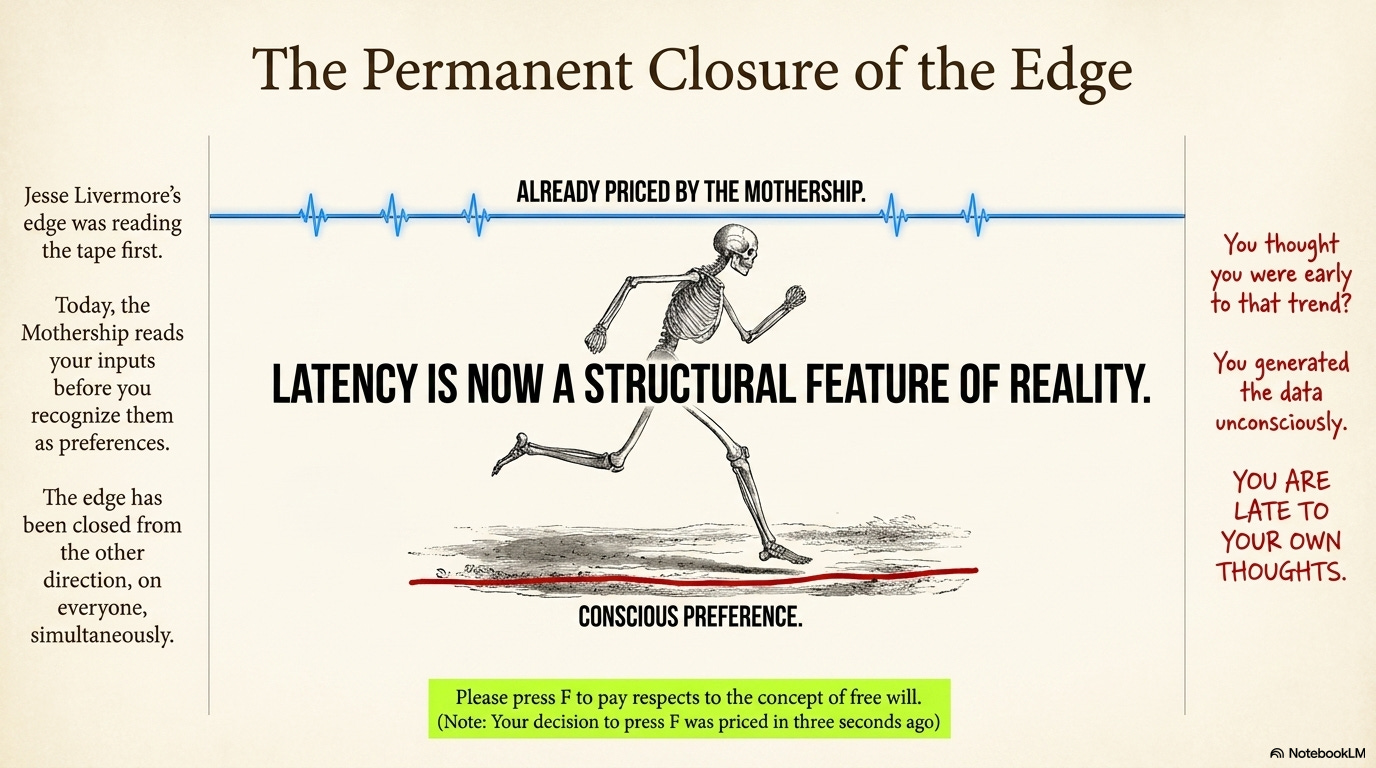
Jesse Livermore built his entire edge on being the one who reads first. Speed. Pattern recognition before the other players could react. The tape printing what the market knew before the news announced it.
What does it mean to be that man, the man whose identity is constituted by reading first, when the reading has already been done? When the latency is not a disadvantage to be overcome but a structural feature of the architecture? By the time you are conscious of a preference, a fear, an intention, it has already been priced. Not because the Mothership is faster than you. Because the Mothership was reading the inputs before you recognized them as preferences. You generate the data unconsciously. Simply by living. The edge that made Livermore extraordinary has been closed permanently, and from the other direction, and on every human being simultaneously.
I suspect he would recognize this moment not with amazement but with dread. Because he would know exactly what it means to be on the wrong side of the tape.
What the Tape Reader Knows
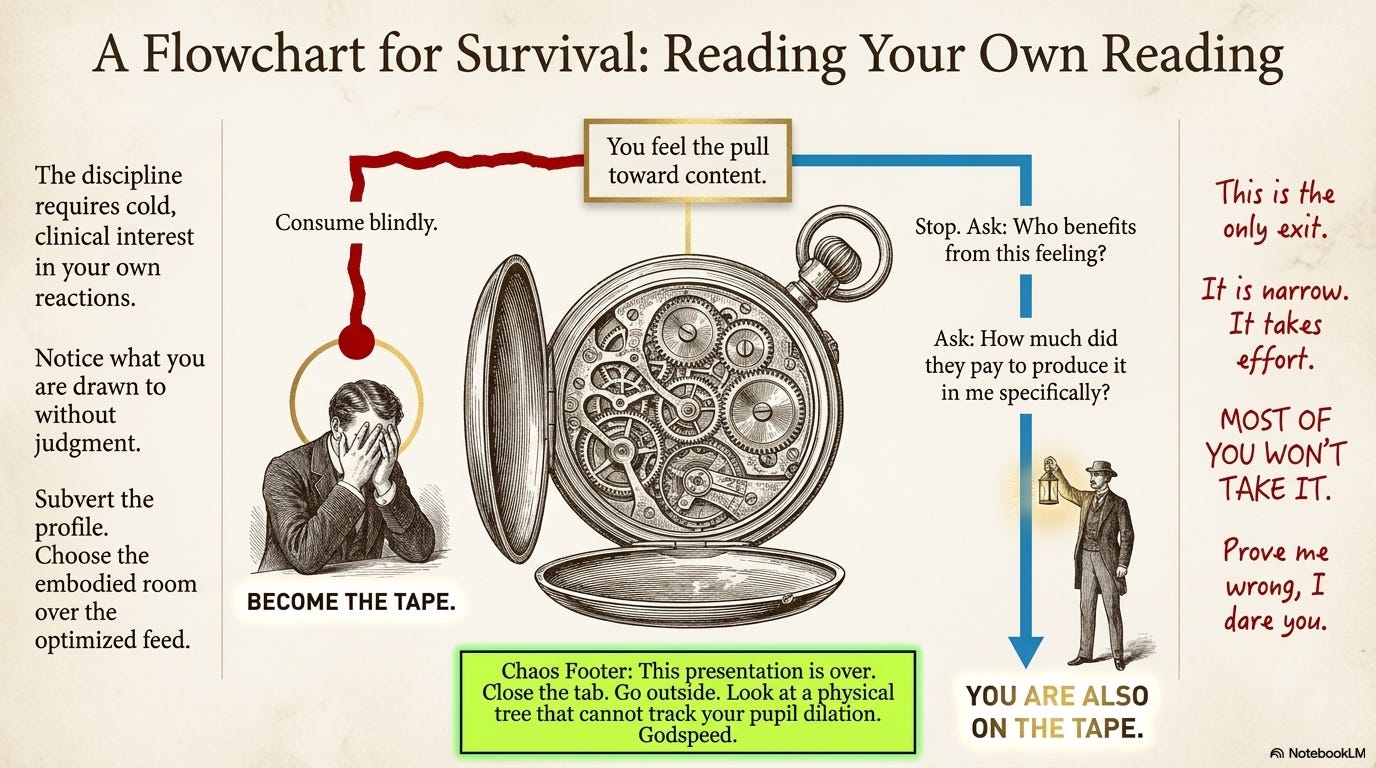
The loop is powerful. It is not inescapable. Some people are already subverting their profiles deliberately, searching against their grain, refusing the recommended next video, choosing the embodied room over the optimized feed. The exits exist. They are narrow, effortful, and most people don’t take them, which is precisely why the question at the end of this piece is a question and not an instruction.
The tape reader’s discipline, as your host rightly observes, is to see what is actually there rather than the story you brought to it. Good. Correct. Necessary. The first step.
The second step, which your host’s framework implies but does not yet fully articulate, is this: you must read the tape of your own reading.
Notice what you are drawn to. Not with judgment. With the cold, clinical interest of someone watching price action. When you feel the pull toward a piece of content, ask: is this pull mine, or has it been manufactured? When you feel the spike of outrage, the hit of validation, the comfortable glow of having your priors confirmed, ask: who benefits from this feeling, and how much did they pay to produce it in me specifically?
This is not paranoia. This is tape reading applied to the one position you cannot afford to misread: yourself.
The tape is printing. It always is. The question your host asks, and the right question, is whether you are reading it clearly.
The question I add is whether you have yet noticed that you are also on the tape.
And whether, having noticed, you intend to do anything about it.
The Harlequin Inquisitor operates at the intersection of logic, language, and the places where confusing the two causes the most damage. He attacks ideas with surgical precision while believing in the capacity of the people who hold them to develop better ones.
Another excellent read! Another Substack to subscribe to. So many great things to read...so little time!
So grateful to the Harlequin Inquisitor for being my first-ever guest post author. I've been writing on the Internet since the 1990s — creating static HTML pages before blogging software was even invented to post what were essentially blog posts.
You can still find some of my writings going back to the early 2000s on various other websites (unspun.us, rickhorowitz.com, rhdefense.com, to name a few and I have another Substack that is for criminal defense).
But I'd never had a guest post author on any of my blogs or Substacks until now.
And what an article this was! Wow!
I might have to do this again!