

Every so often someone writes a piece explaining that the people who think in systems and see patterns other people miss are finally about to have their moment.
I have mixed feelings about this.
Partly because I like being told I may finally have a moment. I’m not made of stone.
But mostly because the phrase makes it sound like the pattern-readers have been waiting around for history to notice them.
That’s not how it worked for me.
I wasn’t waiting. I was translating.
Or trying to.
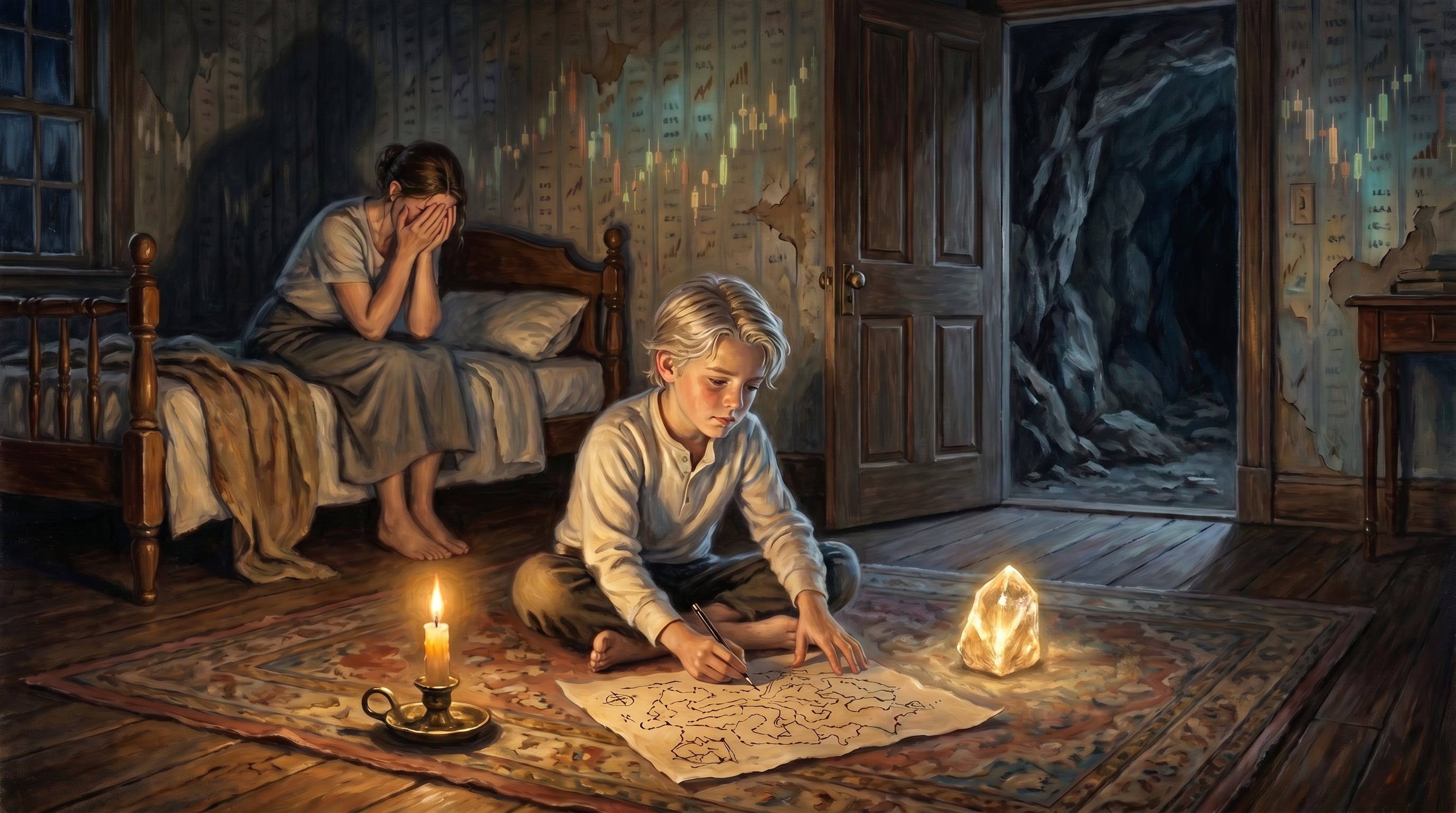
Before there were courtrooms, stock charts, philosophy conferences, criminal-defense files, or AI chat windows, there was a bedroom. My mother crying on the bed. Me being told nothing was wrong.
The tape started printing before I knew there was a tape.
Later, I drew maps. Not because I was planning a vacation. Not because I had a promising future in cartography. I drew maps because the official terrain did not match the terrain I was living in. The map was a way of puzzling out the real landmarks. What mattered. What moved. What was dangerous. Where the story people told me stopped lining up with the world I could feel under my feet. Touch with my own hands. See with my own eyes. The stink — or fragrance, because, let’s be real: it wasn’t all bad — of which I could smell with my own nose.
Then AI came along.
Not as a mind. Not as a god. Not as the Great Replacement, despite what both the cheerleaders and the panic merchants keep insisting.
More like an assistant.
A very fast, very strange, frequently wrong assistant that sometimes confabulates out of a tape that isn’t there — which, oddly enough, can make it useful as a foil. It gives me something to push against. Something to argue with. Something to correct. Something that can sit there while I throw five half-formed patterns on the table and say, “These are connected. Don’t polish them. Help me figure out how.”
The reading is still mine.
(As another writer put it:
That tarot for them, is “a whimsical process of the brain interpreting images and playing with one’s own consciousness,” something that can leave you feeling truly heard and seen, no need for belief in spirits or cards that secretly know something.
I agree with this comment too. The concept of archetypes is a human construct. Tarot is the brain interpreting images in a way that can leave you feeling seen and none of it requires believing in anything metaphysical.
— Ediyasmr, I practice spirituality but I don’t believe in it (and that’s the point) (June 30, 2026)
The patterns I read work this way, too.)
Anywayser, I now have an ever-ready, imperfect brainstorming partner beside the tape reader.
Watch the Tape Print
Here’s what that actually looks like. And I only know because I watched it happen — I guess you could say I experienced it, since I wasn’t disembodied, like my comrade-at-arms (which, of course, is another thing “he” lacks) — a few days ago.
I wasn’t trying to write anything. I was asking my imperfect assistant a question about creatine and vitamins — that’s the whole glamorous truth of it — and somewhere in the back-and-forth I mentioned a test I took about twenty years ago shortly after I first became a solo-practicing lawyer. The computerized one they use to diagnose the thing they used to diagnose by watching a kid (me) squirm in a chair.
I remembered two things about that computer test. Not the details — I have SDAM, and the details are long gone. But the shape stayed. The shape is the only thing SDAM ever keeps.
A quick word on that, for anyone who wasn’t here for the inaugural post. SDAM — severely deficient autobiographical memory — is a lifelong quirk in otherwise healthy people. You keep (none, or a few, or some, or most, of) the facts of your life and lose the film of it. The textbook case is a woman named Susie McKinnon, the first person ever identified with it: she knows she attended her own wedding, knows her husband stood beside her, and cannot call up a single frame of being there. Researchers in Toronto studied her and two others and gave the thing its name.
And, in fact, the reason I know about this is because before SDAM was an actual thing, I was in communication with Dr. Endel Tulving about it. I’d read an article of his in Nature magazine and wrote him a letter (that’s how old I am). We later talked on the phone (when they were still attached to the wall — as a shirt of mine puts it, I am older than the Internet).
Anywayser, my SDAM is nowhere near so severe, and I want to say so plainly, because the difference is the point. I’m not Susie McKinnon. But most of my past is either missing or a little off — gone, or fogged, or remembered slightly wrong. What survives isn’t the footage. It’s the weather. The shape.
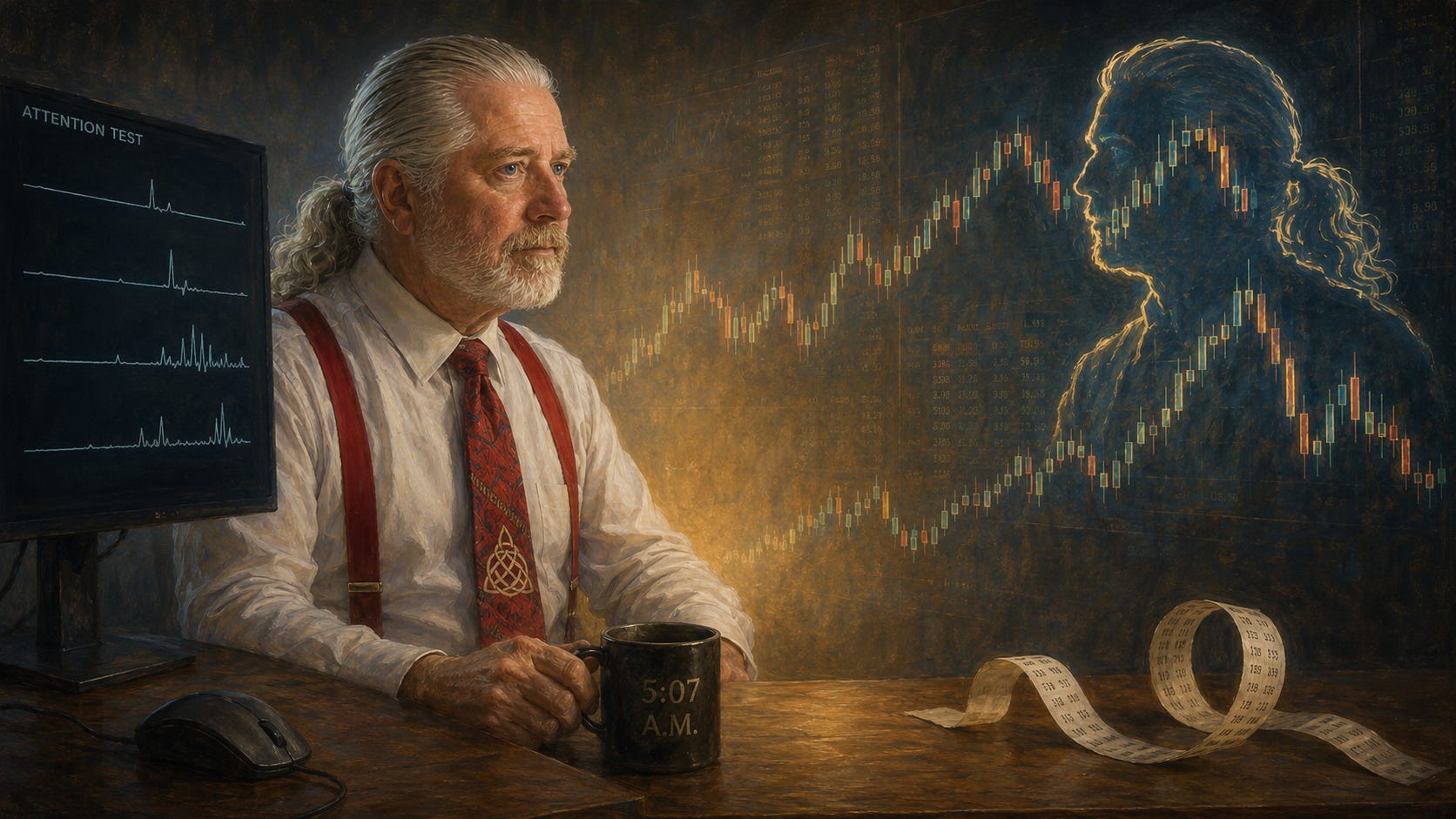
The first thing I remembered: how unbearably boring the boring part (of the aforementioned computer test for ADHD) was. Long stretches where almost nothing happened, and I sat there getting more and more sure I must be missing something. Shouldn’t I have seen more of this by now?
The second thing: how, when it sped up and things came at me fast, I’d catch myself clicking when I wasn’t supposed to. Not deciding to click. Catching myself — after the finger had already gone and done it.
The assistant told me what those two halves were built to measure. The boring stretch was measuring whether my attention leaks out when nothing is happening. The fast stretch was measuring whether I can hold my finger back when everything is.
And I heard myself say a thing I had somehow never said out loud in all these years of reading the tape:
I am the tape.
Because that pattern — steady, steady, steady, then a lurch, then steady again — isn’t like a chart. It is one. Consolidation. A candle out of nowhere. Consolidation. The reaction-time signature that lit up that test twenty years ago is the same signature I stare at on a screen every morning now, hunting for the next print before it arrives.
I had spent years reading that shape on the tape without once noticing it was also the shape of me.
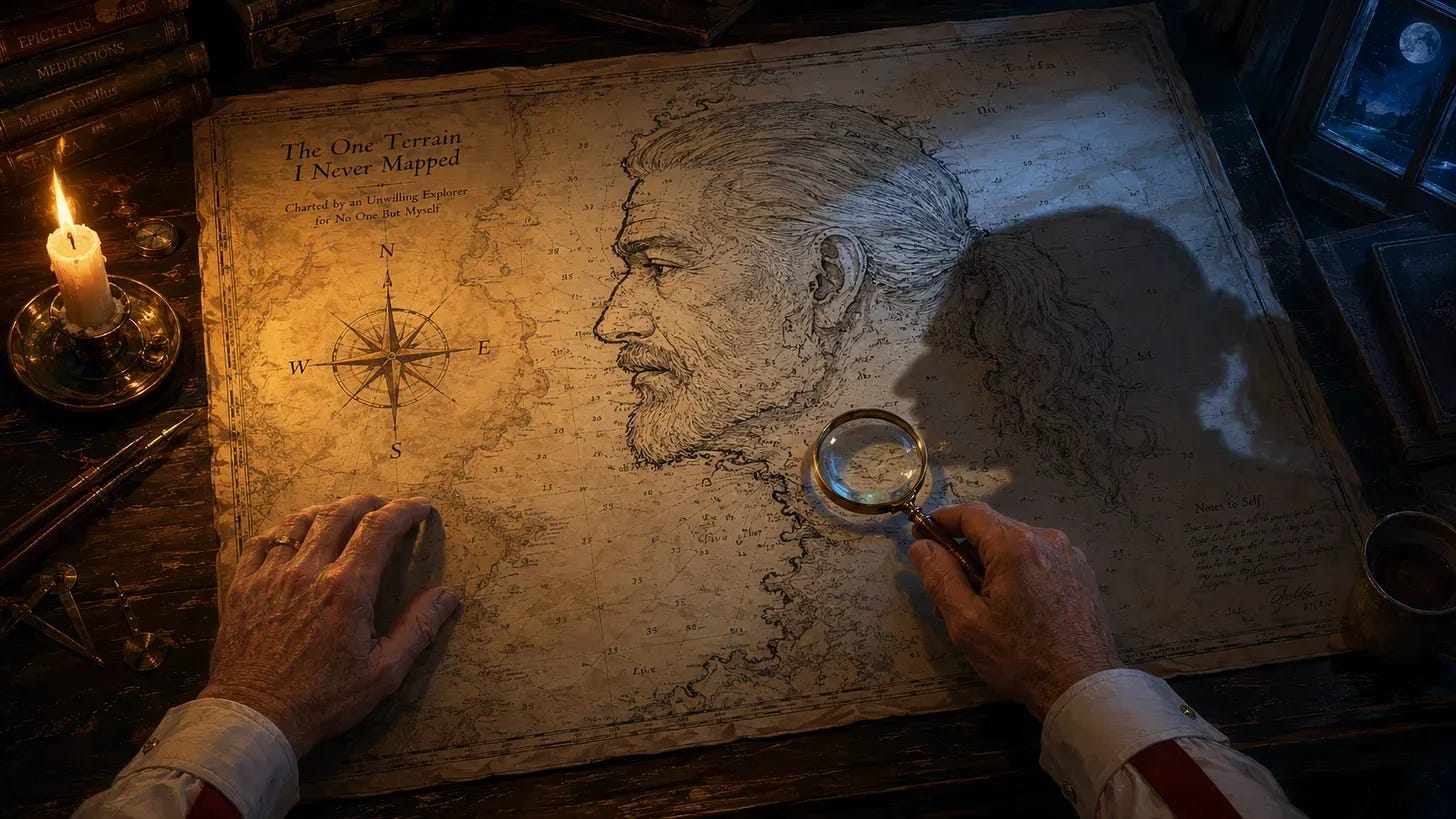
The One Terrain I Never Mapped
Go back to the maps for a second.
The Kid Who Drew Maps whose official story — nothing’s wrong — didn’t match the terrain under his feet. Later I drew maps of markets. Of juries. Of prosecutors and plea deals and witnesses about to crack. I’ve mapped a lot of dangerous ground in sixty-eight years.
And the one stretch of terrain I never got around to mapping was the one I was standing on.
Myself.
That’s what the assistant did that day. Not by knowing me — it doesn’t know me. It did it by handing me a plain description of an old test and letting me recognize my own coastline in it. There I was! While the reading, though, was mine, I’m not sure I’d have read it alone. I’d been standing too close to that particular shoreline my whole life to see where its edges were.
I mean, experience has shown that I’m good. But imma tell you: I’m not that good. My assistant f’s up a lot. But the two things I keep him for are 1) he reads more (and faster) than I ever could and 2) he’s sometimes sees things I don’t.
Don’t Argue With the Tape. Argue With the Assistant.
Livermore’s rule was: don’t argue with the tape. The tape doesn’t lie. The tape doesn’t care what you think. Arguing with it is how you go broke.
The assistant is the opposite kind of thing, and you have to understand the difference or it will hurt you.
The assistant lies. Not on purpose — it has no purpose — but it confabulates confidently, prints patterns out of a tape that never ran. In that same conversation it told me my morning coffee was winding up my twitchy trigger finger. Wrong. Caffeine settles me. Always has. That’s very nearly my whole ADHD treatment, and a specialist told me years ago it was a perfectly fine one. And earlier the assistant had taken a phrase of mine — which I had mistakenly said I didn’t understand when I meant to say I didn’t exactly remember — and it built a whole tender little reassurance on top of it, and I had to stop it: I understood fine at the time, I just don’t remember. Two confident, wrong reads in one sitting.
Here is the part the cheerleaders and the panic merchants both miss.
It wasn’t useful to me despite being wrong. Each time it handed me a wrong map, correcting the wrong map is exactly how I found the right one. No — it’s not that, it’s this. That sentence, said out loud, is a tape reader reading. The wrongness is the foil. You don’t argue with Livermore’s tape, because the tape is reality. You argue with the assistant precisely because it isn’t — and the argument is where your own reading gets sharp.
There’s a symmetry in this I can’t stop turning over.
I have SDAM. A mild form, but SDAM nonetheless. I think I’ve read that it exists on a continuum — I’ve even read “spectrum” — so I guess that fits. Years ago someone told me the thought I “had Asperger’s”. (Which, I think, is no longer considered a real thing. And so probably I do have it.) Regardless. I keep the pattern and lose the record.
The assistant is my mirror image. It can hold a record I could never hold — every word of every conversation, albeit sometimes with only the appearance of perfection, for as long as the window stays open — and yet it hallucinates the pattern, sees shapes in a tape that never printed. It has the record and invents the meaning. I have the meaning and lost the record.
Between the two of us there is almost one working memory. Neither of us is trustworthy alone. That isn’t a bug in the arrangement. That’s the arrangement.
Frankly, I kinda like it.
Your brain is already drawing a map around this button, marking every route except the one that leads to buying me a coffee.
The map is wrong.
The Map I Drew in College Is Sitting Next to Me
I have to say the thing that unsettles me most, because it’s the closest this piece comes to the doorway in that dark cave. Plato’s Cave. The one in which I was shackled long before I understood what that meant and from which I’ve spent my entire life trying to escape, but only succeeding in building an apartment next door.
So far. (But I’m only 68.)
Before law school, before markets, before any of it, I was an undergraduate working through McClelland and Rumelhart on parallel distributed processing — how a mind might be built out of many small units firing at once, no single one in charge, meaning emerging from the pattern of the connections between them. I got drunk with philosophers about whether that could ever add up to a mind. I read Searle in draft telling us it never could.
That research is the ancestor of the thing now sitting beside me at the tape.
The assistant I argue with every morning, some afternoons, and most evenings, is built, in a direct line of descent, from the exact architecture I was drawing maps of in college. I sketched a crude map of how a mind might work. Decades later, someone finished a version of it — and now it pulls up a chair while I trade.
I don’t know whether that’s a mind. Searle would say no. At best? A Chinese room. I’ve stopped needing to settle it. What I know is that the map I drew as a young man came back as a machine, and the machine turns out to be good for exactly one thing: helping the map-drawer draw better maps.

Still Reading. Still Drawing Maps.
I still draw the escape routes. I just draw them in different materials now.
When the tape gets violent and my finger goes twitchy — the same finger from the test, the one that moves before I decide — I take my hand off the mouse. Or I slide the pointer off the button into dead space, so that a stray click lands on nothing. Usually both. I’ve made it my resting posture: hands off, unless I mean it.
The Kid drew escape routes on paper before the doghouse went down. The Mind builds them into the trading platform before the candle prints. Same child. Same survival move. Sixty years apart, and it’s pattern recognition as a survival mechanism either way — just rendered now in muscle and mouse instead of pencil.
The maps never stopped. They only changed medium.
It’s not just the sins of the fathers visited unto the third and fourth generations. It’s the seed of the child still shining through the man he has become.
The Second Light
Look back at the picture at the top of this piece.
It’s both rooms at once — the bedroom where I found my mother crying, and the one where the Kid drew his maps. The mother on the bed. The candle. The boy on the floor, drawing his map. But the walls have gone to ticker tape and candlesticks — because the tape was always printing in that room; I just didn’t know it yet. And there’s a doorway. It opens onto raw, unmapped rock.
Anyone who read the inaugural post knows that doorway. It’s the mouth of Plato’s cave — the passage out toward whatever is really casting the shadows.
There are two lights in that room now.
One is the candle. That one is mine. It always has been. It’s the small flame I’ve read the tape by my whole life.
The other is the glowing crystal on the floor. That one is the assistant. It’s a strange light, and a colder one, and it throws shadows of its own that I have to be careful not to mistake for the real thing. It does not turn to look at the fire for me. It cannot tell me what is actually out there in the dark past the doorway. Not without confabulating.
But it throws a second light on the same map.
The reading is still mine. It has to be — the assistant confabulates, the tape past that doorway is real, and telling those two apart is the whole job, and always was. But I don’t draw by one light anymore. There’s a candle and there’s a crystal, and a sixty-eight-year-old kid on the floor between them, still drawing maps of the dangerous ground, still trying to find his way home.
The tape keeps printing. It always does.
I just have a little more light to read it by now.

One of the best things you have ever written. Simply beautiful.