

This is part two of a two-part series. Part one is The Tape is a Palimpsest: Suffixes, buried paintings, Axixic, and the stories we mistake for reading.
The Next Candle
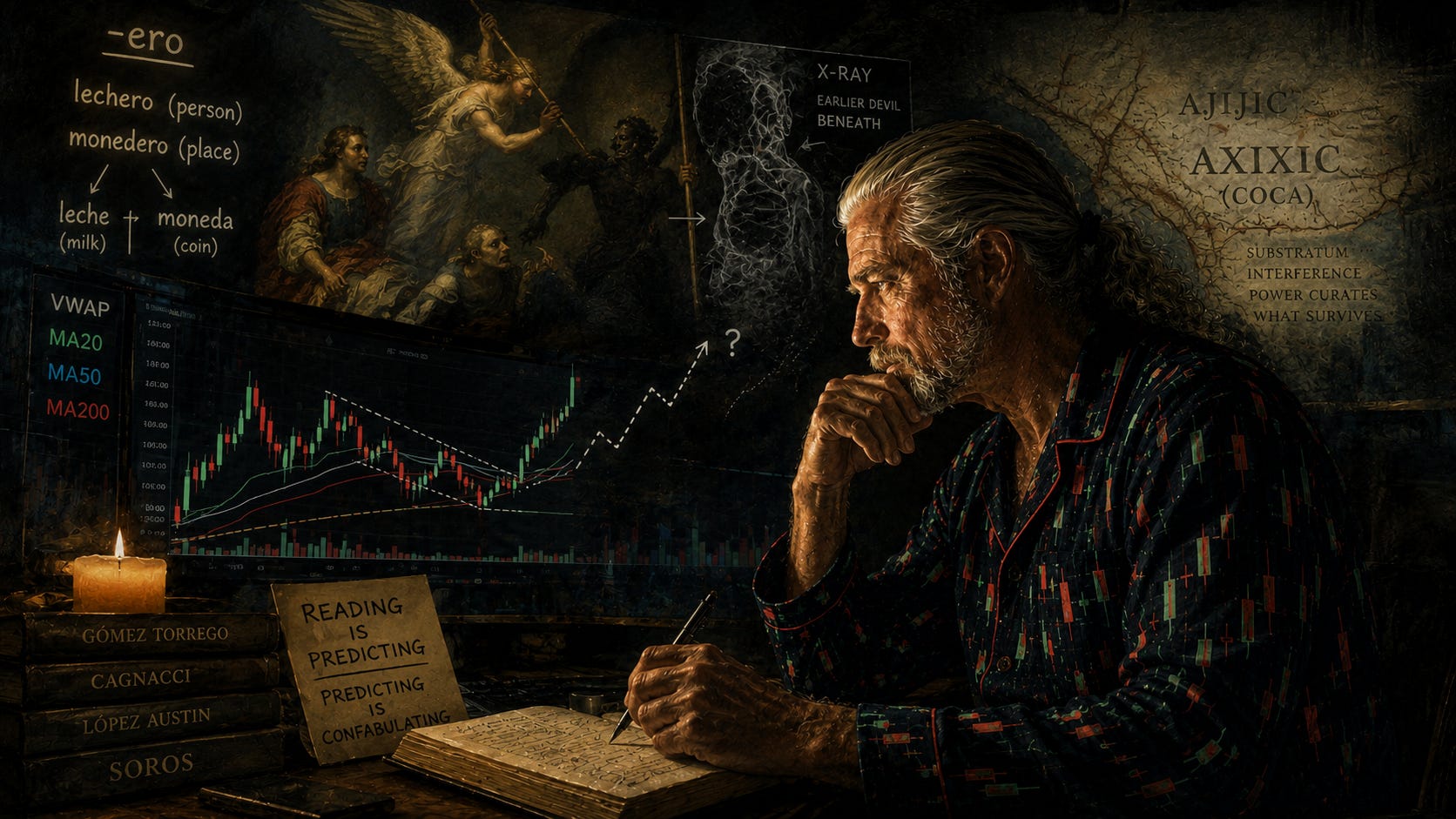
Everything so far has been backward-looking, starting with the suffix. Then the x-ray. And my favorite part: the name under the name.
In each case, I was looking at a surface and trying to figure out what had produced it. Milk into lechero. Coins into monedero. An earlier devil under Cagnacci’s final devil. Axixic under Ajijic, or beside it, or behind it, or somewhere in the mix of Nahuatl, Coca, Spanish, memory, and signage.
But that is not what I was doing at 4:30 in the morning.
At the desk, with the screens lighting up the room and my mood doing whatever my mood was doing, I was not trying to recover the last candle.
I was trying to decide what the next one meant before it existed. And deciding, for once, I hoped, not to pay for the reading with a trade.
And so a candle prints. And then another. I watch — and again there is hoping — for volume to come in. VWAP to bend upward. The moving averages to stack or fail to stack. A flag forms. Or does it only appear to form? And the mind starts completing the pattern before the market has agreed to anything, let alone what I wanted.
The market doesn’t care what I want.
My goal, my aim, or at least my task, is the forward version of the same old excavation problem.
Only now the buried thing is not behind the surface.
It is in front of it. As yet unwritten. Unformed. And if I am not careful, I will remain uninformed — by emotions confabulating a future reality.
The Tape as Autocomplete
Ross Cameron once compared reading candles to completing a sentence — I can’t find the actual video again and it’s driving me nuts — but the analogy stuck because it is exactly right.
You pull up a chart. Like most sane people, I use candlestick charts. And while I watch, a candle prints. Then another. The chart has not told you the future. It has started a sentence.
And, by the way, I like to think that it kind of “stutters”. I pay careful attention to candlestick formation with occasional glances to Level II, to the Active Trader ladder (a Schwab thinkorswim thing; I don’t recommend Schwab, though, and may be switching brokers soon). By the time I’m paying attention to the candle, I’ve already checked out MACD, RSI, VWAP, and the moving averages.
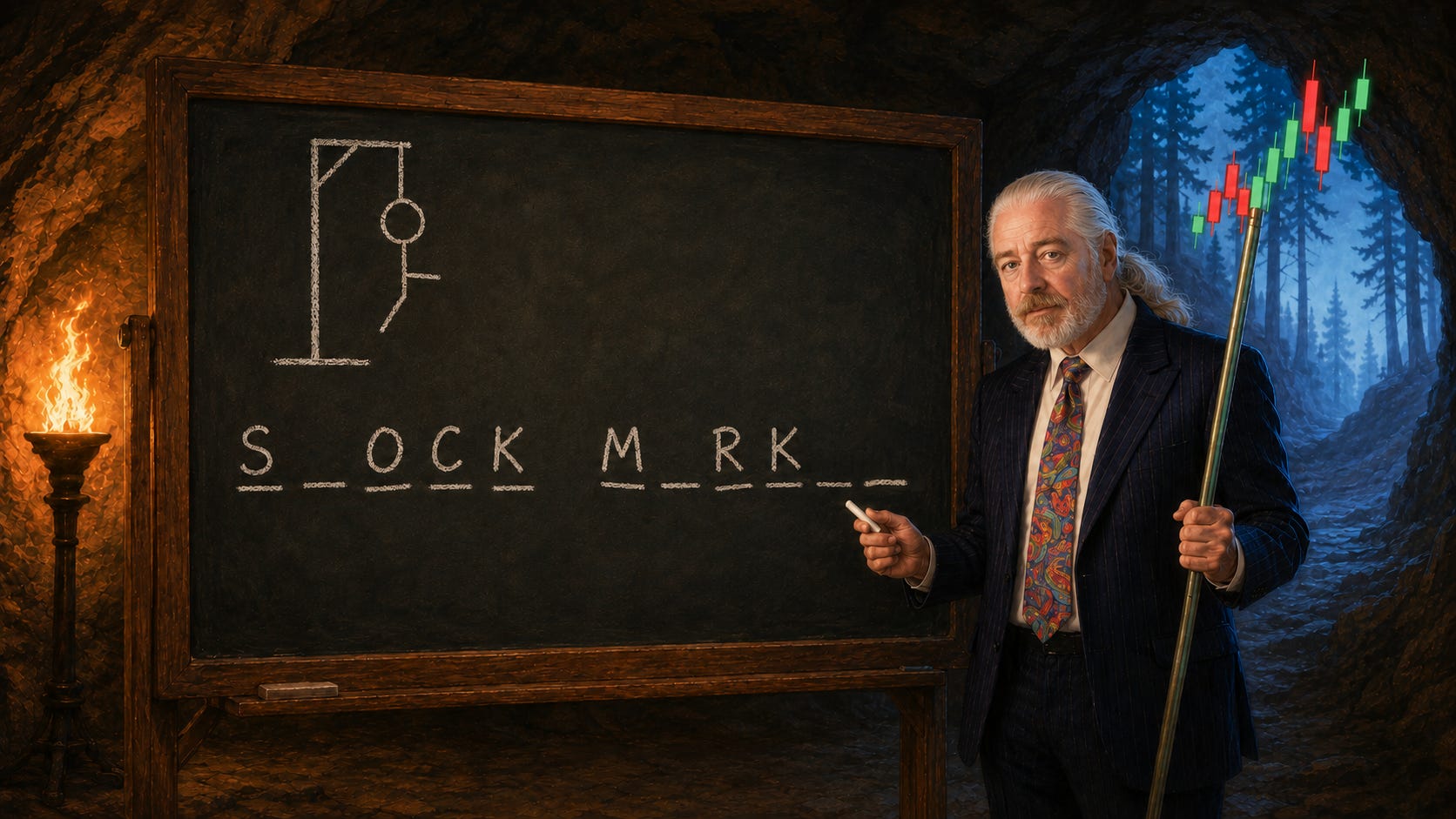
But now? Now I’m watching the candlestick pattern and, particularly, the currently-forming candle. The job is to watch the pattern form and try to understand where things are going. As Ross said, it’s like completing a sentence. Or, maybe — since we’re talking about the stock market — it’s more like a game of Hangman.
And if I want to make this sound more respectable than “Rick remembers something Ross Cameron said in a video he can no longer find,” there is Shannon’s Prediction and Entropy of Printed English.
In 1951, Claude Shannon played what later came to be called the Shannon game: given a stretch of English text, try to guess the next letter. If you miss, keep guessing. The easier the next letter is to predict, the less information it carries. The harder it is to predict, the more uncertainty remains.
Shannon was talking about letters, not candles. But the game is familiar: given what has already printed, how much of the next thing is still uncertain? So this is not just a trading analogy. It is the old prediction problem wearing a candlestick chart.
The chart gives me context. My brain narrows the field. The next candle becomes the next letter. I have a part of a word or sentence. And my brain, helpful little bastard that it is, supplies the next letter or word.
That’s what a bull flag is all about. Or an ABCD pattern. They don’t know anything. They don’t know whether price is going higher. They don’t know whether the next candle will break high of day or roll over and make me feel like an idiot. They’re just traces. Measures. Prints. Shapes made from what has already happened. Pictures on the screen.
But they narrow the continuation possibilities.
Or they appear to.
And that’s the hook. The chart gives me enough structure to make the next move feel less like a guess. The first few words are on the page. The sentence has a rhythm. The next word seems almost forced.
Almost.
And “almost” is where the money goes to die.
Because the market isn’t completing my sentence. It’s writing its own. In fact, even that isn’t the right way to put it. It’s just printing candles.
I’m sitting there with my charts, my lines, my prior examples, my Ross Cameron Warrior Trading videos, my TraderVue scars, and my desperate little wish not to be stupid twice in the same way. The candle doesn’t care. The tape doesn’t care. It prints.
Sometimes the next word is exactly what I expected. Sometimes the sentence turns. Sometimes, frankly, it’s just gibberish.
“Markets are rational, until they aren’t.”
Prediction Is Confabulation
That’s where the trouble starts.
Because when the next word is exactly what I expected, I call it reading the tape. When the sentence turns, I call it a fakeout, a bad read, a failed setup, or — if I’m being honest — me seeing what I wanted to see.
But from the inside, those do not feel like different acts.
The confidence is the same. The pattern feels the same. The little internal click feels the same. The difference only shows up after the market prints the next candle and either confirms the story or shoves it back in my face.
Kind of makes me sound like ChatGPT or Claude or just about any other LLM, doesn’t it?
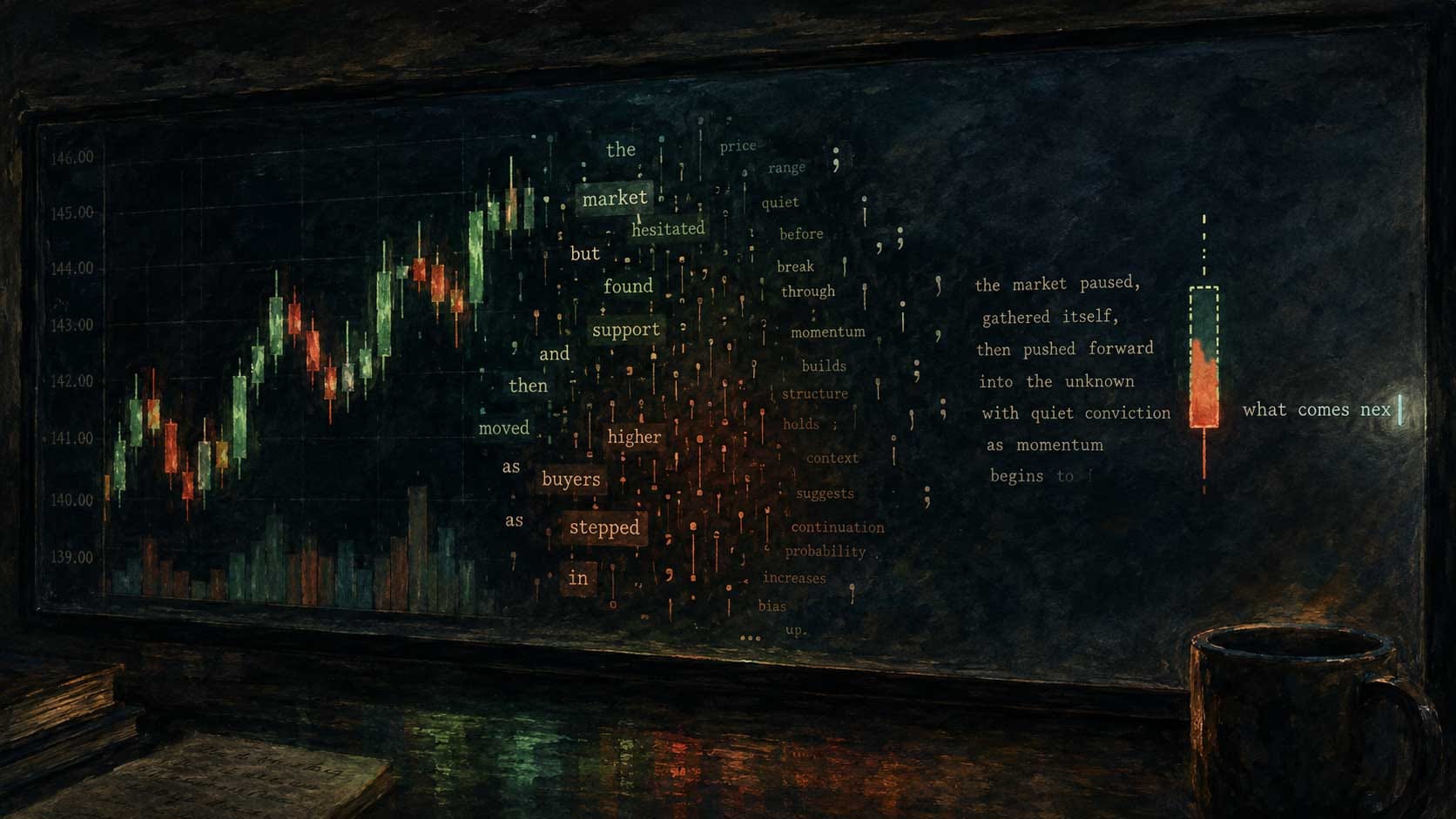
But this is also where the analogy can get sloppy. LLMs do not think, doubt, believe, remember, worry, or feel the little internal catch that sometimes tells a human being, wait, maybe I’m making this up. They compute continuations. They have context. They have prior tokens. They have patterns learned from an absurd amount of text. Then they generate the next likely thing.
Sometimes the next likely thing is right. I mean, it almost has to be, right? That’s Shannon. Or Bulkowski.
Sometimes it is nonsense wearing a tie. Some people might call that a lawyer. Or, more accurately, a judge.
That is why I keep coming back to confabulation instead of hallucination. Confabulation is not lying. It is the mind filling in a gap and then experiencing the filled-in version as if it came from the world rather than from the filling. The clinical literature tends to reserve the word for the failure case, but I am less interested here in the label than in the machinery. The machinery is ordinary. Brains complete. They smooth. They infer. They supply missing connective tissue and most of the time that works well enough so we can call it memory, judgment, intuition, or reading the tape. The trouble begins when the completion outruns the evidence and I mistake the sentence in my head for the next candle on the screen.
When a machine gets it right, we call it reasoning. When it gets it wrong, we call it hallucination. Both words flatter it. It isn't reasoning, and it isn't seeing things that aren't there. It's completing — the same thing I'm doing at the desk, minus the part of me that occasionally stops and asks whether I'm making it up. (Whether there's any real thinking in there at all — and the people who build, or “grow,” these things have every reason to keep that blurry — is another article.)
And so as with the machine, so with me. I take a stab at candlestick sentence completion from context. When I get things right, it’s reading the tape; when I don’t, it’s a miss.
And here is where it gets worse than autocomplete, because sometimes the sentence has been salted.
Take spoofing. Someone stacks a big bid a few levels down — size that says support, size that says get in before it runs. My brain does what brains do: it reads the bid and completes the sentence in the direction the bid implies. Then, before it ever fills, the order vanishes. It was never meant to print. It was a false word dropped into the sentence for no reason other than to make me complete it wrong. A feint aimed straight at the completion machinery — not at the market, at me.
And then there’s the slower, stranger version, where the salted word turns out to be mine.
TACO wasn’t mine to coin — the acronym was already out there, Trump Always Chickens Out. What was mine was the completion: I watched the pattern that day — the threat, the markets clutching their pearls, the quiet capitulation — and I read TACO onto Schrödinger's War while the candle was still forming. I called the sentence before it finished printing.
And, finally, Bloomberg’s Javier Blas surfacing the new trading-floor acronym. We thought we were getting a TACO. So far we are getting a NACHO: Not A Chance Hormuz Opens.
— Rick Horowitz, The Half-Life of a TACO: He Who Should Not Have Been Elected and the Fouling of the Markets (April 30, 2026)
Which is just Axixic again, run forward — only this time I’m not the one who got buried. I’m a guy in his pajamas who read an obvious pattern a beat early and reached for a name someone else had already coined. The financial press read the same obvious thing, louder, with a chyron. Nobody overwrote me; we all completed the same sentence at roughly the same time, and the loudest completion became the record. That’s not a grievance. That’s just how the pen works — it was never in my hand, and it was never going to be.
Your brain is right now confabulating a story about why you don’t need to click this button. The story is wrong. Buy me a coffee.
Schrödinger’s War Causes a Flinch in Schrödinger’s Market
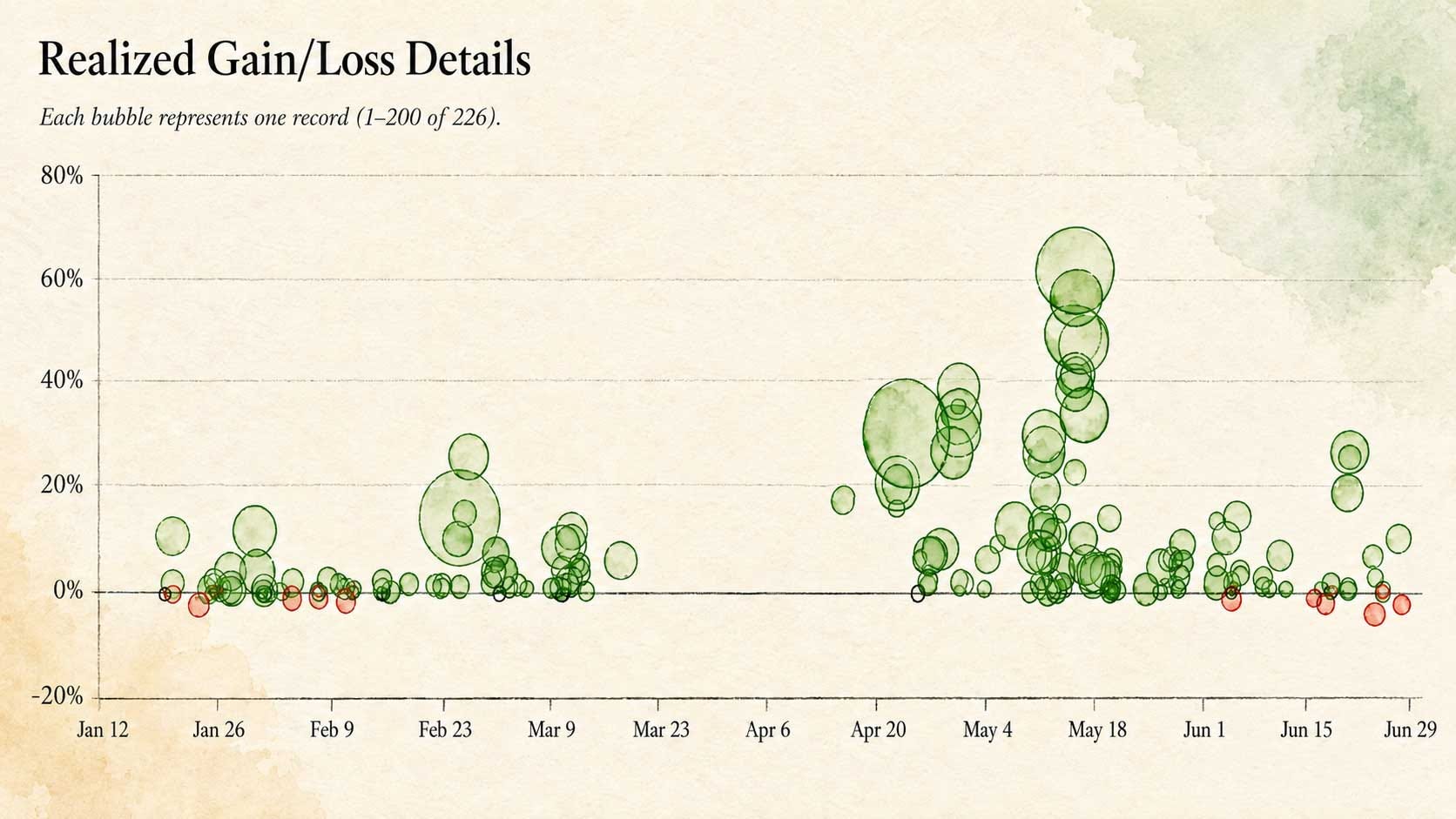
Usually, language creates more predictable patterns than the markets. The probability constraints really do limit what comes next. The vocabulary is finite, the grammar holds still, and q is followed by u whether or not I bet on it. English doesn’t rearrange itself because I guessed. Shannon could run his game across the same passage a thousand times and the passage wouldn’t move.
But markets are reflexive and non-stationary. Regularities drift. The market moves because I guessed. Because others guessed. Because we all guessed.
That’s the whole difference, and it isn’t small. Markets are reflexive and non-stationary — the regularities drift, and the worst part is why they drift. They drift because we predict them.
When enough of us learn that the bull flag breaks upward, the bull flag stops politely breaking upward. It gets front-run by people positioning for the break. It gets faded by people betting against people positioning for the break. The edge doesn’t get disproven; it gets crowded, arbitraged, and worn smooth until there’s nothing left to take. The pattern is real right up until it’s useful, and being useful is what kills it.
This is Soros’s word: reflexivity. The thing I’m studying is studying me back. My prediction isn’t a neutral reading of the system — it’s an input to it.
It works like a traffic signal. Green means go because everyone agrees green means go; the sign has power only because it’s shared. That’s also the trap: the moment a pattern is shared widely enough to be reliable, it’s shared widely enough to be eaten. (I could go the other way and trade some private contraption — a 3-period SMA, a VWAP redefined so only I know its parameters — but a sign only I can read directs no traffic. The crowd is what gives a signal teeth, and the crowd is what blunts it.)
All of this changes when the sign stops meaning any one thing at all.
This is where the War walks into the Market. Schrödinger’s War — a deal signed, void, and torn-up all at once. But watch what repetition does to it. The war is over. The strait is closed. The strait is open. The war is over again. The boy cries wolf so many times the cry no longer resolves to wolf or no-wolf — it just becomes noise that every trader on the tape reads differently. That’s the moment the single market, the one we all price together, splits into as many markets as there are readers. Schrödinger’s War becomes Schrödinger’s Market: I price the certainty, the look collapses it, and the next look collapses it somewhere else, because the sign itself has stopped holding still.
The mirror doesn’t just flinch. It flinches differently every time I look.
And I can’t step back far enough to catch it doing that — because I’m in the glass with everyone else. I’m at the desk in the wee hours of the market in candlestick pajamas, wearing the exact rumpled pattern I’m trying to read on the screen.
From inside the act, I can’t tell the difference between catching a real, fleeting regularity and imagining a flag in the noise because I wanted a flag to be there. Both feel like reading the tape. Both come with the little click. The only thing that tells them apart is the next candle — the one thing I don’t have, the thing I’m trying to front-run by reading in the first place. The thing I thought would clarify my edge.
When what would become Schrödinger’s War first started — when it had not yet warped trading into Schrödinger’s Market — I had to take a step back for about a week. The patterns were whipsawed back and forth by every asinine statement from an asinine President’s mouth.
It took me a minute to get my footing back and then, ironically, I immediately had the best month since I started day-trading late last year. I learned to pay attention to what the horse’s ass was saying.
But now the horse’s ass has become the boy who cried wolf. Worse. He’s turned the Illegal Iran War into Schrödinger’s War and the Bull Market That Wouldn’t Quit into Schrödinger’s Market. As happened when Nahuatl erased the Coca language, so it seems to me that He Who Should Not Have Been Elected has written over normal market signals.
Last Print for Greenspan
Let’s close this by noting that Alan Greenspan died today. One hundred years old, Parkinson’s, announced by his wife.
They called him the Maestro. For two decades he was the closest thing the market ever had to a man who could read the tape — except his readings didn’t just describe the market, they moved it. In irrationally non-exuberant ways.
He knew it, too. That’s why he mumbled on purpose, why he built a whole dialect of fog: he understood that when he looked, the thing he was looking at flinched. He even gave us the phrase for a market telling itself a story the evidence won’t back. Irrational exuberance. Confabulation in a good suit.
And then the Maestro’s own most confident read — that the banks could be trusted to mind themselves — turned out to be the biggest confabulation on the board. He didn’t find out until the candle printed. None of us did. Later he said the only honest thing there is to say: I made a mistake. I had the wrong model and I couldn’t feel that I had it.
So here’s what I’ve got, having sat musing more than one night in my candlestick pajamas with a fraction of his information and none of his authority. If Alan Greenspan couldn’t tell from the inside whether he was reading the tape or writing one, I’m certainly not going to. The next candle hasn’t printed. Neither has yours. The only move I trust anymore is the one I made that morning — reaching for the keyboard instead of the mouse, working on this series instead of ill-read trades. Not predicting the thing. Just keeping an honest record of having guessed.