


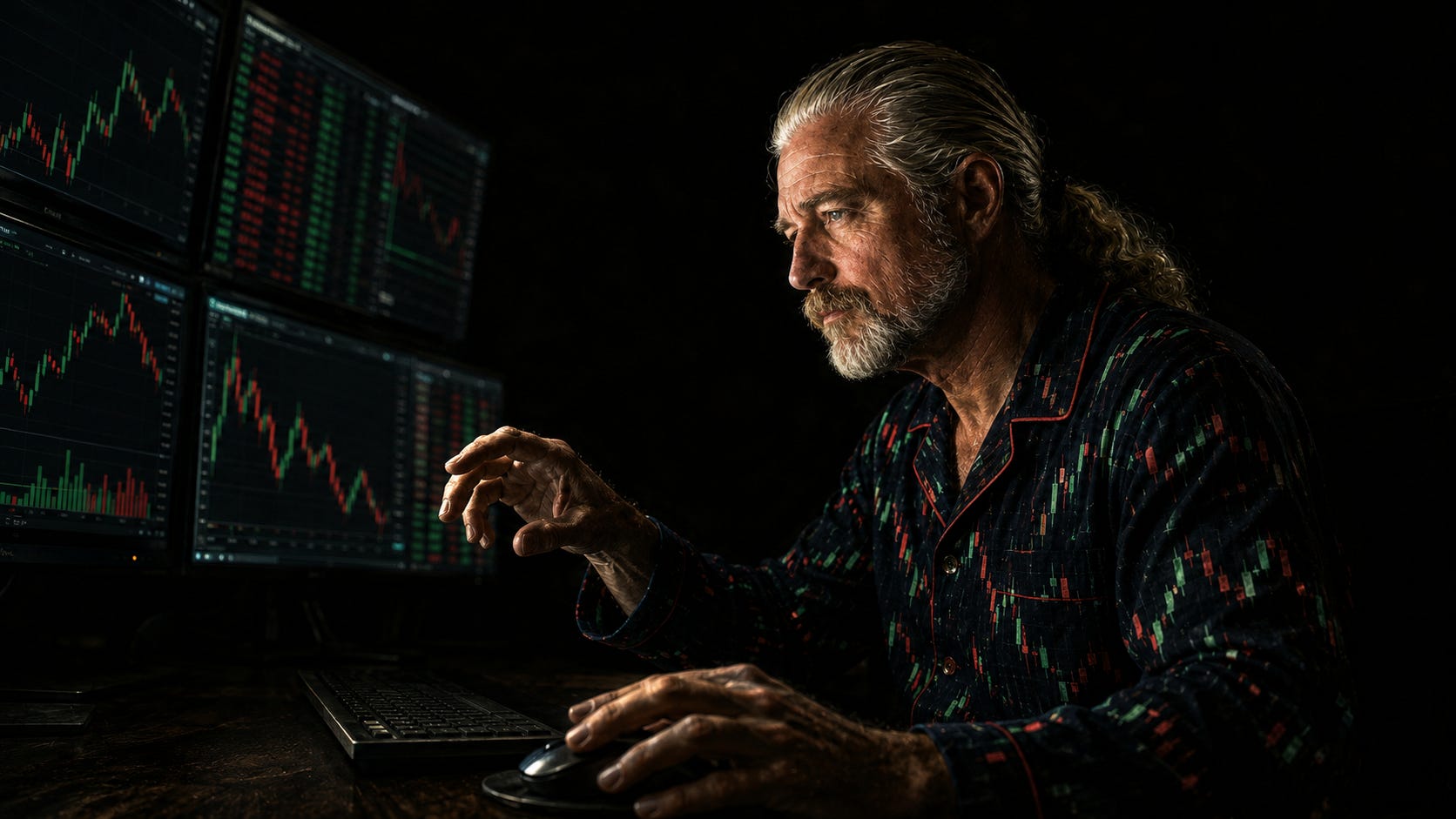
It’s the wee hours of the morning — probably 4:30, but I didn’t make a note of it — and the only light in the room comes from my trading screens.
Which, like my mood, are mostly black.
Sunday, TACO TACO’d. Having previously lambasted and then torn up the deal that Obama made with Iran back when the world and presidential administrations were more sane, Trump managed to cave to a deal that led to a joke that isn’t really funny so much as it is true.
TEHRAN (The Borowitz Report)—In an astounding achievement for a first-time author, on Wednesday Ayatollah Mojtaba Khamenei nabbed the #1 spot on the New York Times bestsellers list with a business book entitled The Art of the Deal.
…
An advance excerpt from the book’s first chapter begins, “Rule #1: Only negotiate with morons.”
— Andy Borowitz, Ayatollah’s ‘Art of the Deal’ Becomes #1 Bestseller (June 17, 2026)
Anyway, for as long as I can remember now I’ve been watching the market price a certainty out of a thing that is signed, void, and torn-up all at once.
Henceforth, the Illegal Iran War should be known as Schrödinger’s War.
The Tape is a Palimpsest
The Word as Dig Site
Earlier in the night, I’d been reading Gómez Torrego’s Gramática didáctica del español. (Amazon Affiliate link.) I was reading about suffixes. And, in particular, there was the suffix “-ero” which Gómez Torrego noted with these examples:
En lechero, el sufijo -ero significa ‘persona que realiza una acción.
En este caso, ‘persona que vende leche’.En monedero, ese mismo sufijo significa ‘lugar’. En este caso, ‘lugar donde se guardan las monedas’.
— Leonardo Gómez Torrego, Gramática didáctica del español § 1.1.2.8 “Sufijos de significado no gramatical”, loc. 3807 (SM 2007) (Kindle ed.)
For my non-Spanish-speaking readers:
In the word “lechero,” the suffix -ero means “a person who performs an action.”
In this case, “a person who sells milk.”In the word “monedero,” that same suffix means “a place.” In this case, “a place where coins are kept.”
For reasons that don’t matter here, I got into a discussion about this with Claude at 1 a.m. in the morning and Claude peeled back another layer which, once I read it, made total sense.
The -ero in lechero doesn’t really mean “person who performs an action.” It attaches to a noun — leche — and means roughly “person associated with, or who deals in, that noun.” The selling is inferred from context; nothing in -ero itself says “sell.” A zapatero works with shoes, a panadero with bread, a carnicero with meat, a portero with the door. So the suffix is relational/agentive over a noun base, and “realiza una acción” quietly papers over that.
Which actually makes the book’s person-versus-place contrast cleaner than the book states it. The real common thread between lechero and monedero isn’t “action” (for the person) versus “place” (for the container). It’s that -ero forms a noun denoting something characteristically associated with the base noun — and whether that something lands as a person (the agent: milk-dealer) or a place (the container: coin-holder) is settled by convention and context, not by the suffix having two different meanings. Same machine; usage fixes which kind of thing comes out the other end.
— Claude, Spanish Conversation at 1 a.m.
So Gómez Torrego is giving a useful classroom simplification. Claude is pushing into the machinery underneath.
The suffix does not literally mean “seller” in lechero or “place” in monedero. It marks some conventional association with the base noun. Usage then melds that association into a person, container, place, instrument, etc.
Gómez Torrego was doing with his grammar what grammarians often have to do: making a working distinction clear enough for a learner to use. In lechero, the suffix points to a person. In monedero, it points to a place or container. Good enough. Useful enough.
But at one in the morning, “good enough” is exactly the kind of phrase that makes my brain balk.
Because the suffix does not really contain the act of selling. There is no tiny verb hidden inside -ero that means “to sell milk.” Lechero is built on leche. The person is associated with milk. He may sell it, deliver it, produce it, process it, or belong to the whole social world in which milk becomes an occupation. The selling is not in the suffix. The selling is maybe what we’ve been taught to think of here, but it’s layered on top of a deeper meaning.
The same thing happens from the other side with monedero. The suffix does not suddenly become a little word meaning “place.” It attaches to moneda, and Spanish gives us something associated with coins: the thing where they are kept. A coin-holder. A purse. A container.
So -ero ends up in two different locations — please forgive me — by way of one process.
That was the interesting part. Not that Gómez Torrego had made some terrible mistake. He had not. The clean textbook distinction of person here/place there hid the deeper operation. The suffix didn’t give me two unrelated meanings. It showed me a relation, and the language slightly mislead me into completing the rest.
A panadero is not “bread” plus “a person who performs an action” in the abstract. He is the bread-person, the person whose role is organized around bread. A zapatero is the shoe-person. A carnicero is the meat-person. A monedero is the coin-thing.
Spanish (or any language) doesn’t stop at the morpheme and announce the rule. The rule runs through use, habit, history, and convention until the meaning just “feels” obvious.
There’s the seduction. (It’s also why someone trying to explain to me how something works in Spanish stumbles at times. They know “what’s right” but they don’t always know why.)
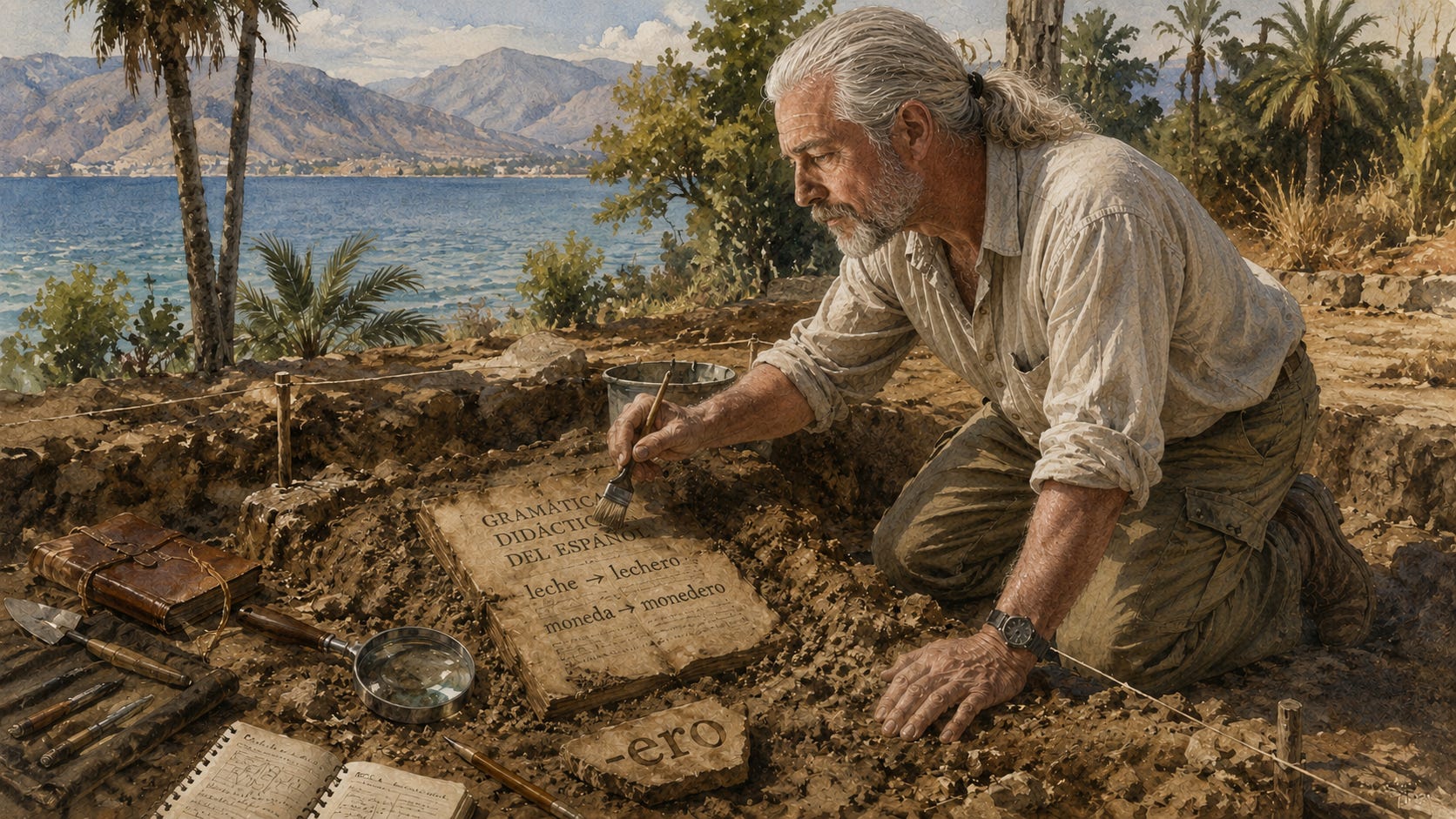
But once I see the trick, I want to keep at it. It’s how I learned English as a child: reading the etymology of words in the dictionary and thus “accidentally” expanding my vocabulary so that I understood new words when I saw them because of their components. I look at the surface and try to recover the hidden layer. The word becomes the dig site. The visible forms lechero and monedero promise an invisible structure. You scrape away the ending, identify the base, infer the relation, and in that moment the move works.
Leche → lechero.
Moneda → monedero.
And there it is, you think.
Not a proof, exactly. More like that little internal click when the pieces appear to line up. I strip off the suffix, find the noun underneath, infer a relation. And then? I feel like I’ve seen through the word instead of merely reading it.
That feeling is sometimes the problem. And it was not new.
The Buried Lede
Years ago, I wrote a ridiculous little story about Guido Cagnacci, aliens, and how taking Art History in college apparently qualified me to become Minister of Intergalactic Arts & Culture. (E.F. Hutton also made an appearance.)
But underneath the joke was a real painting: Martha Rebuking Mary for Her Vanity. And underneath the painting — actually underneath it — was another version of the painting.
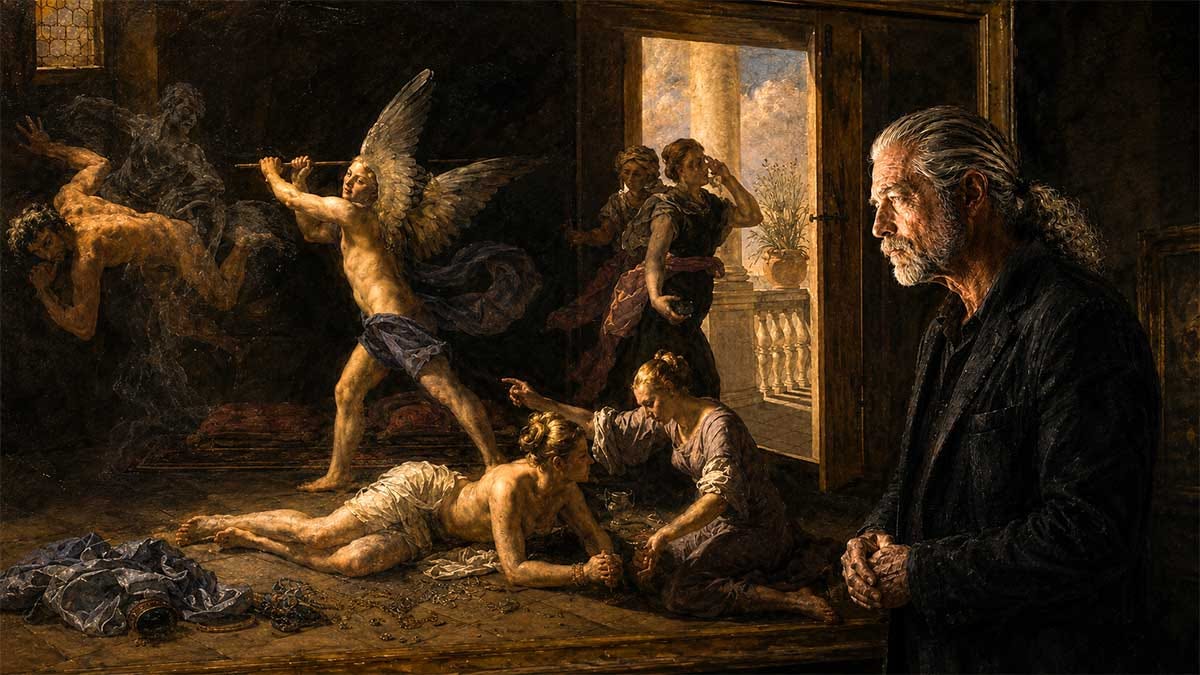
At the museum where I viewed the painting, I saw a picture of an x-ray showing that the devil had originally been painted with both feet on the ground, in a position more like the angel’s. In the final version, the devil is more prone, more clearly paired with Mary, while Martha and the angel stand on the other side of the composition, rebuking in stereo.
So there it was again. A surface. A buried layer. A reason to think the buried layer mattered.
Only this time, unlike lechero and monedero, I could not get there by stripping off a suffix. I needed something else. The x-ray did what my little grammatical autopsy could not do. It showed an actual earlier state. What I found wasn’t a rule inferred from use, but a physical trace of Cagnacci’s revision.
That is still reading, I think. But it is already less clean.
The Name Under the Name
And then there are cases where even the x-ray is not enough.
A suffix is generous; it has a linguistic backdrop. A painting may still keep its earlier self under the paint. But names — place names especially — are not so cooperative. They pass through mouths, governments, maps, priests, clerks, conquerors, tourists, real-estate agents, and people who think they heard what they did not hear.
Which brings me to Axixic.
Although it might look like it, I’m not really trying to give you a tour here of my past writings. But my whole life has been about digging for patterns and the real meaning behind them. And I did write before about language contact and historical linguistics, because this problem fascinated me: what survives when languages and peoples collide, and how much of the older layer can still be recovered after history has stepped all over the evidence?
This is a harder version of the same question that has occupied me my entire life.
With lechero and monedero, that surface form is a base noun and a suffix. With Cagnacci, the x-ray gives a physical trace of revision. But with a place name, especially one that has passed through conquest, transcription, tourism, and time, the thing underneath is often not recoverable in the same way. Or it may be recoverable only as a set of competing guesses.
I see the surface form sitting there. But there’s a glitch in the matrix. Something underneath seems to have produced it. And I want to know whether I am recovering the buried thing or merely imagining a better-looking skeleton.
I visited Ajijic last August. We’re considering moving there. I wandered around — fitting to what I’m doing here, looking for a bookstore — and took a lot of photos.
Here is a re-rendering of one such photo.
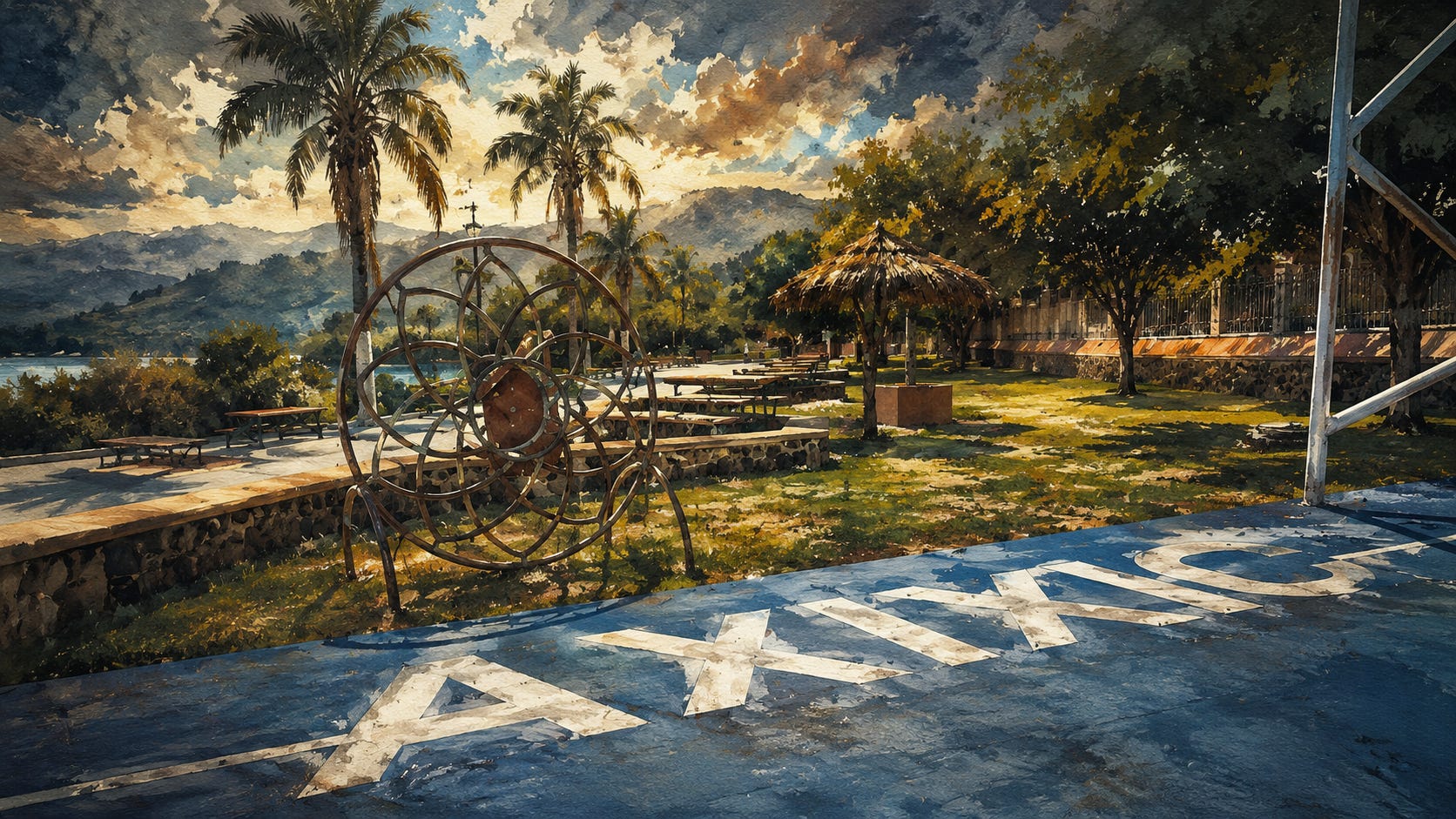
AXIXIC.
Not Ajijic. Axixic.
There it was, painted in enormous white letters across the blue pavement. The older spelling dragged back into the sun and laid down where no one could miss it.
Naturally, my brain immediately asked what I’ve come to call “the excavation question”. I knew enough to think this was Nahuatl.
And that is the usual explanation. Axixic comes from Nahuatl and means something like “place where the water springs forth” or “place where the water runs.”
That makes sense when you are standing there near Lake Chapala, with the mountains behind you and the whole town sloping toward the water.
But that explanation is not as clean as it first looks.
Because this isn’t a suffix anymore. It isn’t leche plus -ero. It isn’t a painting holding its earlier self under the paint. It’s a place name that has passed through Indigenous speakers, Spanish ears, missionaries, clerks, maps, church records, local memory, tourism boards, real-estate brochures, and people like me standing there with a phone trying to figure out what the name is really about.
And that leads me to the Coca problem.
The Lake Chapala region was not some blank Nahuatl grammar exercise waiting for me to parse it. The Cocas were there. Other names show up in other accounts. Caxcan. Tecuexe. Nahua. The categories shift depending on which source I’m reading, which century I’m reading about, and — as with so much in the world of power and existence — who’s doing the naming.
So I have to be careful here.
When I say the Coca language is extinct, or nearly erased from the evidence, I do not mean the people are gone. They are not. People in Mezcala (artículo en español) still identify as Pueblo Coca, and there has been work to recover (artículo en español) at least a symbolic presence of the language from the fragments that remain.
That matters.
Because fifty or one-hundred-fifty to one-hundred-fifty-five words (artículos en español) isn’t nothing. But it isn’t a language in the way Spanish is a language sitting there in Gómez Torrego, with suffixes and sections and examples waiting for me at one in the morning. But it also isn’t nothing. It’s memory refusing to become silence. It’s a community saying: something was here, something was taken, and we’re not going to let the record close over it — or us — completely.
Which makes my little excavation problem feel different.
With Axixic, I am not just dealing with a word on the ground. I am dealing with a name that has passed through Indigenous speakers, Spanish ears, missionaries, clerks, maps, church records, local memory, tourism boards, real-estate brochures, and people like me standing there with a phone trying to figure out what the name is really about.
So when someone says, “Axixic means the place where water springs forth,” (or “where the frog abounds”) I don’t think the answer is wrong.
I think: yes, probably. Maybe. That might be the best available reading.
But it’s also a reading that has already passed through several hands before it gets to me. Nahuatl. Coca. Spanish. Missionary records. Local legend. The modern Mexican state. Expat websites. A painted sign on the ground.
By the time I stand there looking at AXIXIC, I am not excavating one buried object. I am choosing among layers.
That’s a bit different (okay, it’s very different) from seeing through a word.
And it is much closer to creating one.
This is the part I do not especially enjoy admitting.
By the time I’m choosing among possible buried forms, possible histories, possible meanings, I’m no longer just reading. I’m completing. Adding to the found skeleton. I’m supplying the missing connective tissue. I’m making one version feel more inevitable than the others.
LLMs aren’t the only language models who confabulate.