

If y’all — yeah, I use the word sometimes, too — have read much of my writing and especially my writing over at Probable Cause you know that I frequently talk about the drawbacks and overblown optimism of the AI Bros.
But you also know that I actually use AI sometimes. For things it is best suited to doing.
Now, to be brutally frank, I was a little taken aback at how upset the post that motivates this article made me when I first saw it.
Here’s the post in its totality:
Do y’all feel it?
Teachers and parents want Chromebooks out of elementary classrooms.
Middle schoolers are speaking out against iReady.
College students are booing AI.
Human connection is making a comeback.
— Emily W. King, Ph.D., Misguided Note on a Mis-used Tool (May 15, 2026)
Ok. To be fair, Dr. King did not use that title. Substack Notes don’t have titles. So I had to come up with something.
And that one fit.
You might disagree with me, but the logic and rhetoric of this Note is what stuck in my craw. When as a criminal defense lawyer I write legal briefs — or even Substack articles — I frequently “go for the jugular,” by which I mean, I point out the illogic of opposing counsel’s argument.
Here, there really is no argument. What we have here is a pattern presented as a conclusion. The rhetorical form is doing a very large part of the work here.
Don’t get me wrong. I know you did not and will not be clicking on the link to “Substack articles” above, which would take you to my other Substack, where I’ve done much more writing about AI’s negative impact on the criminal justice system, but if you had done so, you’d know I’m not a big fan of AI.
When misused.
Which is almost all the time that it’s used.
What Dr. King Gets Right
Before we get into the meat of what I mean — it just struck me: change out one letter and you get a totally different thing! — imagine what happens if you change out one tool! — let’s talk about what Emily gets right.
Parents, and lots of other people, do object to screens. I mean, sometimes I laugh. Sometimes I shake my head. Sometimes I just honk my horn at the people who are staring, unmoving, into their pubic areas at a light that has just turned green.
You’ve done it, too. (The laughing, the shaking of the head, and the honking of the horn.)
And students do hate certain platforms. They always have. Hell, some students hate that first period, second period, and sometimes third period come before the first break. Even more so if their school happens — as my high school did — to have a snack bar where you could get things like maple bars or even cheeseburgers (if you had enough money).
And teachers — maybe Dr. King is a teacher or a teacher of teachers — they’re watching things go wrong in real time.
I’m not even getting into the “AI is taking our jobs” crowd here.
So, yeah, AI is producing a genuine backlash. I’m not going to argue that this friction is imaginary. The friction is, in fact, real. But the real question is “What’s causing it?”
That’s where Dr. King’s diagnosis goes off the rails.
The Wrong Easy Metaphor
We’ve all heard the cliché. I’ve used it myself even though I’m as tired of it as you probably are: “if the only tool you have is a hammer, then everything looks like a nail.”
Bleh.
This lets Dr. King off the hook far too easily. She has plenty of tools. She has a Ph.D. That comes with training, I think. Lots of reading, I think. Reviewing numerous studies in the area of her Ph.D. — which I hope was teaching, since that’s what we seem to be talking about, but perhaps (A)I should not assume.
And, one would hope, the capacity to look at institutional decisions, since that’s what she’s complaining about.
This cliché, though, doesn’t quite fit. Something sharper is needed. Something sharp, perhaps, on one end, but able to be misused by the blunt end.
The Screwdriver Method for Pounding Nails
And so we come to it. You’ve all at least seen it. Hell, almost all of us have occasionally done it.
What do you do when the only tool you have is a flathead (or, hell, a Phillips) screwdriver and you have a nail? But not a hammer?
Don’t laugh.
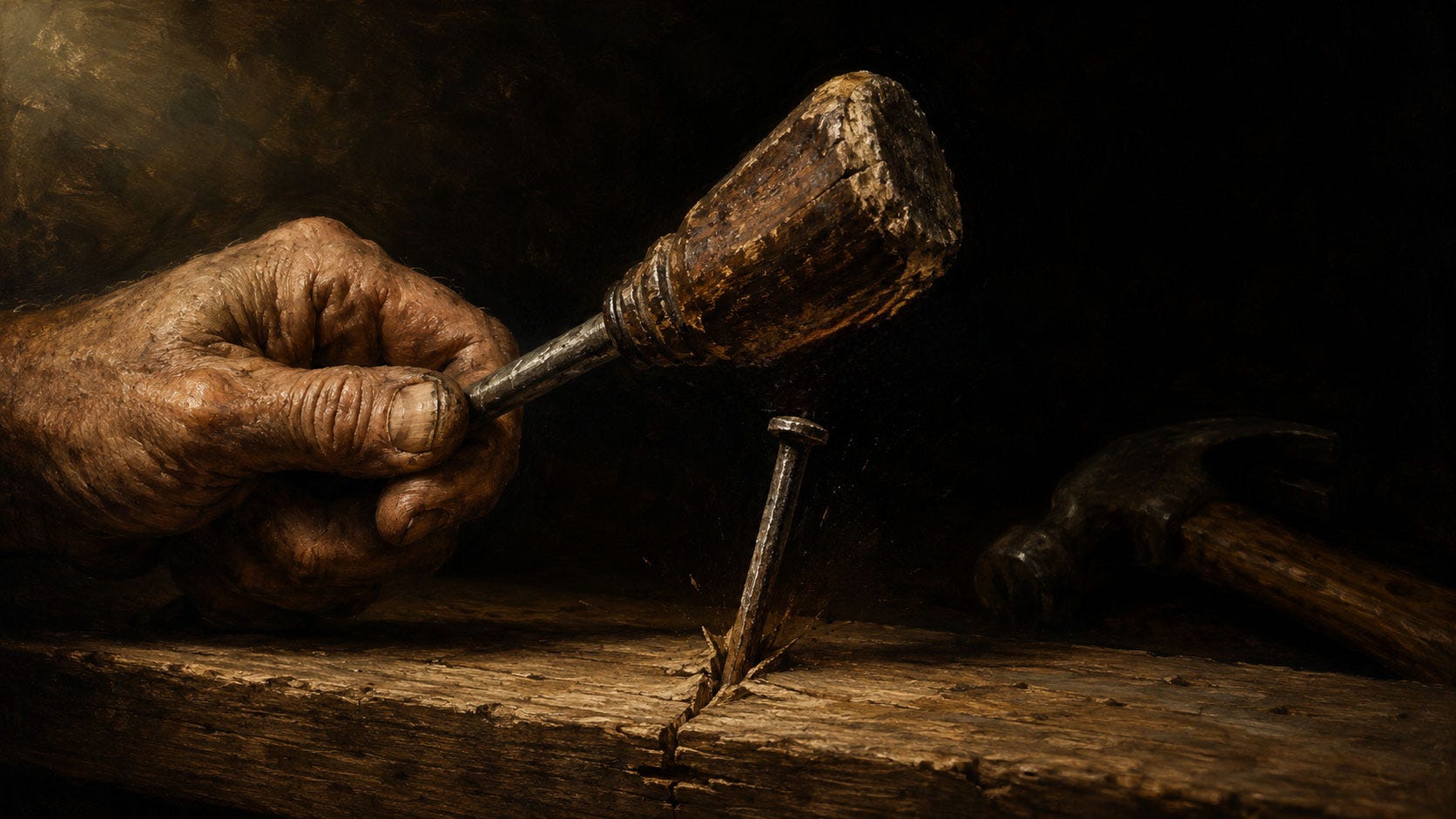
You grab the flathead end (or, hell, the Phillips end) and you hammer the nail in using the handle end as the mallet. And the nail goes in.
That is the problem!
Using the tool incorrectly and then the method failing would be easy to reject. But a method that “half-works” builds confidence. (AI loves confidence, by the way. Again, this is one of the things I target about the misuse — and even the proper use — of AI over and over again.) The wood splits. The nail…it goes in crooked if it actually goes in. I mean, sometimes, because you’re using the handle of a screwdriver, the nail is whacked sideways enough that it just flies across the room.
But when it works!
The hand walks away thinking the method has been validated. The nail. Is. In. The. Board. It all kinda sorta works.
Except that often it doesn’t.
The Wrong Rulebook for the Pattern
So here’s what we have. The pattern that Dr. King recognized? It’s real. AI has brought with it — as every new “technology” — and I put that in scare quotes because this includes things like the cotton gin as well as the spreadsheet or the search engine or the smartphone — friction, pushback, and institutional incoherence.
In their days, VisiCalc in 1979 was widely cited as the killer app that pulled personal computers out of hobbyist garages and onto desks. Excel reshaped finance. Whole categories of work — accounting, budgeting, financial modeling — got re-engineered around the grid.
The rulebook then, as now, is “humans versus machines.” Or, maybe, trying to avoid purely luddidic approaches, I should say “Chromebooks are not pedagogy. iReady is not education. AI is not alienation.”
These are, instead, mere instruments inside systems built by (human) adults.
The reflexive blame is assigned to the instrument because the instrument is the visible thing. We’ve a screen. An algorithm. A platform. But none of this addresses the slower, harder, more accountable question: who decided to put it there, what were they trying to achieve, and what were they trying to avoid having to do themselves?
The Stove and the Menu

When I first saw Dr. King’s Substack Note, I restacked with my own comment. Her note is already quoted above. I modeled her “argument”. I pointed out that the absence of cooking equipment is not the same thing as “a meal.” Frozen dinners are not proof that cooking is dead. Bad cafeteria pizza is not an indictment of fire. Or heating.
A stove can burn food, mass-produce garbage, or make dinner possible.
The question was never “did the invention of stoves destroy the creation of a good meal?” The question was, “who chose the menu? who is cooking? who chose the ingredients?”
And whether anyone sits down at the table.
Trading as Lived Analogy

Ok. So far, so good. You (hopefully) understand my complaint.
But how does this connect back to what Reading the Tape is normally about?
Well, the truth is that it “half connects.” You see, most of my writing about AI and thus most of my thinking about AI, comes from Probable Cause. This includes foundational articles like Naming AI’s “Problem”: Confabulation, Bullshit, or Both?". As well as all the other articles I’ve written on the misuse of AI in helping judges trample constitutional rights to bail before any finding of guilt, or assessing “dangerousness” to deny diversion programs, or coming up — sans human — with a “proper” sentence.
But the other half is with recognizing the pattern. Reading the tapes, as I repeatedly say here. And, in this case, applying the wrong rulebook with real consequences.
A scalp set-up gets read as a swing trade. A swing gets managed like a scalp. A position is held — I admit this is one of the things I have to work on myself the most — because the mind quietly rewrote the trade after entry.
The chart did not lie. The pattern was readable. The rulebook being applied did not fit.
The hammer did not result in seeing the problem as a nail. The hammer was not available. The screwdriver was recruited as a poor substitute.
That kinda sorta worked.
Maybe.
Except there was a recognition that the tool used did not work without recognizing that the tool was being incorrectly used for a task for which it was not designed.
To bring it back (again) more explicitly to trading, the trader applied the Day Trade Rule Book when the Swing Trade Rule Book was the right tool for the stock.
Why the Error Feels Invisible
The mind does not experience itself applying the “wrong” framework. We all think — Dr. King thought then and I think right now — that we’re making sense. How could this not make sense? Confabulation fills the gap between what’s observed and what fits the Rule Book. Paradigms protect themselves against anomaly. Our attitudes toward the tool and the “nail” on which we use the tool reshape the pattern we perceive.
Again, I’ve written about all this before. In the interest of brevity I’ll just remind you of Tulving’s work on episodic versus conceptual memory, Loftus’s work on the reconstructive aspect of memories, Kuhn’s work on paradigm shifts, and Soros on reflexivity’s way of altering reality.
What we have here, in all fairness to Dr. King, is not the personal failing of one Substack Note writer.
This is just what happens when we grab the first tool from the first drawer of the tool box.
And fail to notice how we are misusing the tool.
Your brain is right now confabulating a story about why you don’t need to click this button. The story is wrong. Buy me a coffee.
The Right Tool at the Right Time for the Right Job
If you’ve read enough of my articles — and if you haven’t, why not? — you’ll already know what I said above: I’m not a huge fan of AI.
This particularly comes through when I’m talking about all the ways that AI can go wrong. And of the ignorance of believing that AI is going to become intelligent, or even just replace human beings, doing the job of those human beings just as well.
You know, like when you get trapped in that hellhole we all encounter when trying to reach customer service and the AI Help Assistant directs us to a website that has an answer for a question we did not ask, instead of the one we are asking.
And so we come to me saying again, in plainer language: “I hate AI. I use AI. It (sometimes) helps me do things I could not do without it.”
But what do I use it for? And what do I not use it for?
I’m using it for things I can’t do, like creating an image that will help illustrate a point I’m trying to make. You’ll have seen examples in this article and in every other article I’ve ever written on Substack.
I use it for brainstorming. And, yeah, sometimes it totally misses the point. Have you ever brainstormed an idea with a good friend — not that I’m calling Claude a good friend, mind you! — who misses your point? Isn’t that actually part of the whole brainstorming experience? ChatGPT and Claude (the two LLMs I use the most, although there are others at times, like Gemini and NotebookLM and Ollama and others). But in a brainstorming session, even a partner who misses the point focuses you on the point.
Sometimes I ask an LLM to summarize something. It might be a case I’m working on as a criminal defense lawyer. It might be an article I deem too long to read but potentially useful for Reading the Tape. These are things about which I know something. So I get a summary. Sometimes, I push back on the summary.
Whoa! Combination of brainstorming and summarization!
And sometimes I ask an LLM to pick apart — to attack, to play Devil’s Advocate in response to — my own arguments. The generation of friction that, again, makes me think a little harder about what I’m trying to say.
Best of all? I repeatedly feed my partially-written and then completed articles to it and ask for a critique. At the very end, it told me that I’d written
“systems build by (human) adults” — “build” should be “built.” Typo.
Oops.
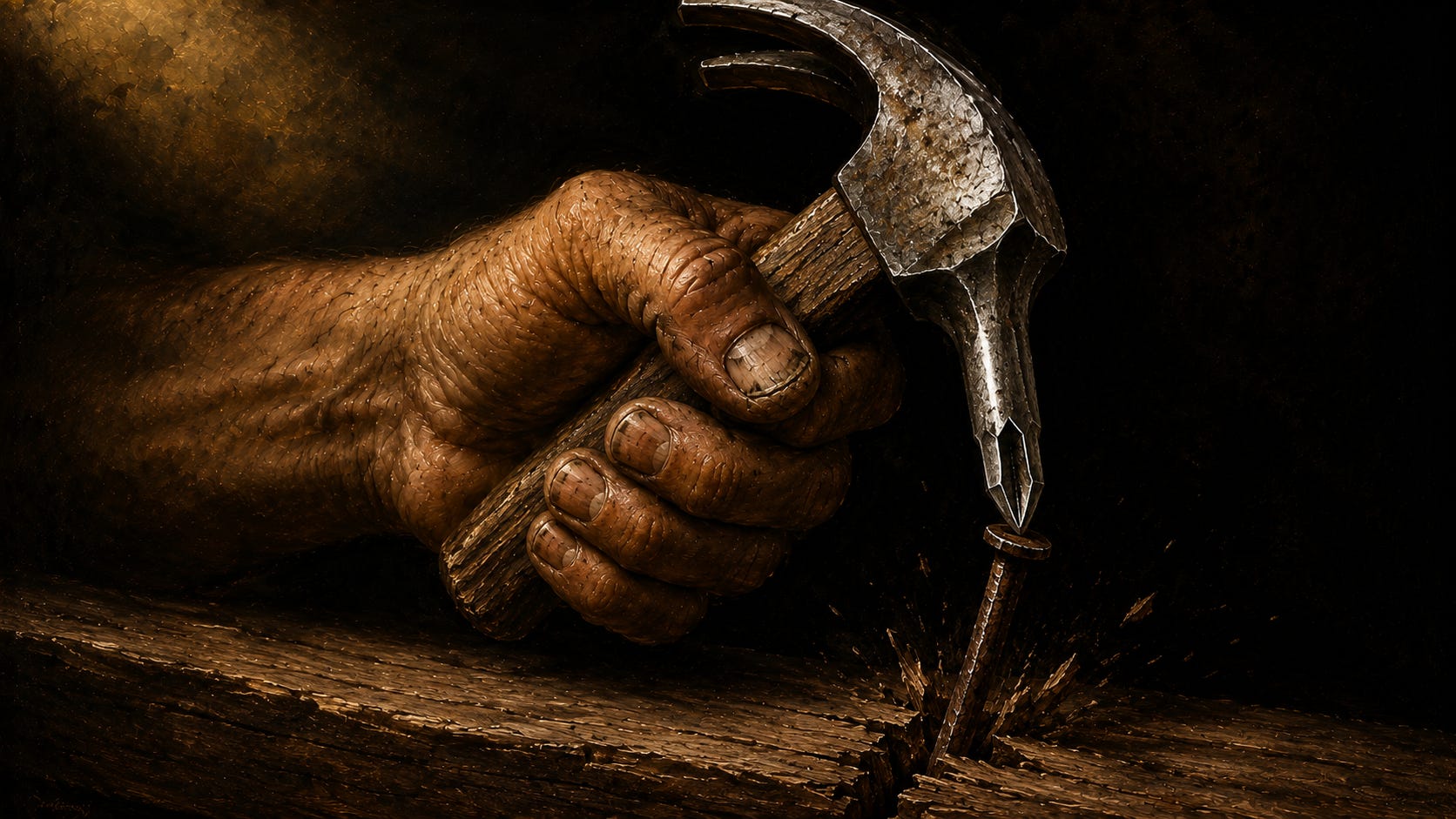
The point here is not that “AI is good at what it does.” The point is that AI has a jagged frontier: it helps with some tasks, fails badly at others, and requires a human being who knows the difference. And just like the hammer is limited to driving nails — or should be, unless you’re using the claw end to pull nails — and the screwdriver is only kinda sorta sometimes useful as a substitute for a hammer, the expert tool user needs to be aware of where the failure modes for each tool live and must know when to override the tool. Or substitute a different tool.
That’s the discipline.
This is the same in trading. The same in cooking. Litigating. Or parenting or teaching for that matter.
The screwdriver doesn’t get rejected. It’s just gripped at the right end and used for the right task.
Unscrewing the Nail
The students booing iReady aren’t booing software in the abstract. They’re booing the inchoate notion of how adults made them live with it. Parents wanting Chromebooks out aren’t rejecting technology in the abstract, either. They’re reacting to a curriculum decision that some adult somewhere made for some unknown reason and is no longer around to explain or to be held accountable for.
The stove is not the menu. The nail going in is not proof the method worked.
Dr. King saw the nail go in and called the method sound. She saw the rejection of a new tool and a retracement to an older way of doing things and pronounced that as the right approach. But the board is split. The nail bent.
The real problem was that the screwdriver was never a hammer.
Another great point! Rick, you see things...think about things...in ways I never could. I always look forward to reading your posts. They make me think!