


Note that some facts in this story have been changed to protect the possibility of accidentally “outing” someone who might not want to be outed. However, I felt like this was important to write about for a variety of reasons that I hope will become obvious as you read this article.
The website in question, though, is real. So if you happen to run across it, hopefully this article will save you some heartache.
The Contact
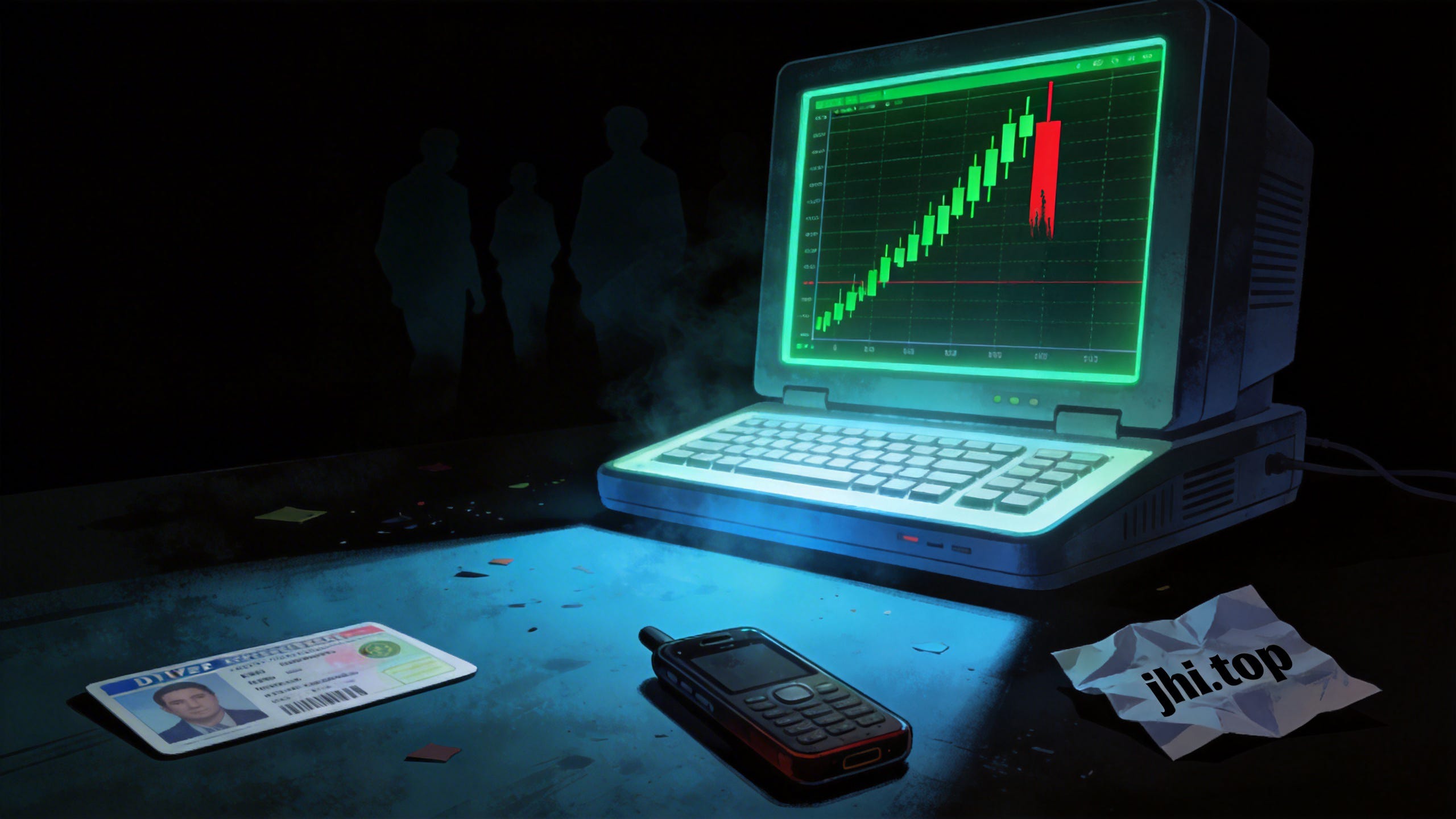
Someone reached out. A family member had put money into jhi.top. Small amount, showing gains, but when they tried to withdraw, the site wanted a driver’s license. And when they searched for any trace of the platform anywhere online, they found nothing. Not a bad review. Not a good review. Not a Reddit thread, Facebook post, or tweet. Nothing.
And that’s when they got scared.
They were right to be scared. But they were asking the wrong question. They asked: why isn’t anyone talking about this?
The right question is: what does the silence tell you?
Reading the Tape
In trading, the absence of data is still data.
For example, one of the banes of my existence as a trader is spoofing. A bid that evaporates. What happens is that, for whatever reason, someone wants to keep a price down. Or up. Or right where it is. In the thinkorswim trading platform, which I use, there are several ways to see prices. There’s the Active Trader ladder. The Level II data. Time & Sales. And, of course, the candlestick minute or minutes (depending on what you choose), hours, days, weeks. You get the picture.
There are also tick charts, but you don’t care about those, do you?
To my knowledge, most traders — and I’ll admit I don’t know how right I am about this, but it’s my belief — prefer to watch Level II. I used to prefer — and still favor — the Active Trader ladder. Mostly that’s because the way I’ve got things set up, that ladder sits right next to where the more recent candles are printing on my one-minute and five-minute charts.
But maybe this is too much detail.
The point is that the Active Trader ladder and Level II are both susceptible to spoofing. This is where someone, or something (e.g., an algorithm) puts up fake and often outrageous numbers concerning how many shares are available for sale at a certain price and how many buyers are bidding at a certain price.
Doing this seems to scare off the ignorant traders. They see 10,791 shares on the sell side of the ladder for $7.01 and they think that’s as much as it’s worth. Or they see a similar number on the buy side and figure there’s no point bidding less. You might also see smaller amounts that move around right above that large number on the sell side or below the large number on the buy side.
What’s this got to do with the absence of data?
The tape. The tape reveals what’s real. The numbers I just talked about — the spoofs — change constantly. But if you look at Time & Sales, which is essentially the digital version of the old ticker tape, you will see that although the spoof numbers are constantly changing, no such numbers of shares are actually being bought or sold. If you depend solely on Level II or the Trader ladder, you’re watching prints with no follow-through.
This absence of data tells you the spoofers are afoot. And once you get your head wrapped around that, you also can read other things from the spoofing: like how desperate the spoofers are, how much resistance they’re running into trying to scare people one way or the other up or down the ladder.
So the first thing that absence of data tells you is that someone is spoofing you. This same principle applies outside the trading arena. Here, with jhi.top, it indicates that a scam is staring you in the face, begging you to follow its illicit lead.
Because as you know if you’ve read any of my articles, in trading, we talk about reading the tape — interpreting the flow of orders, the shape of volume, the things the market reveals when you know how to look. Sometimes the most important signal is an absence. A stock that should be moving and isn’t. Bids that evaporate the moment you lean on them. A print that comes in off-hours and leaves no trail.
The tape doesn’t lie. But it also doesn’t announce itself. You have to know what the silence means.
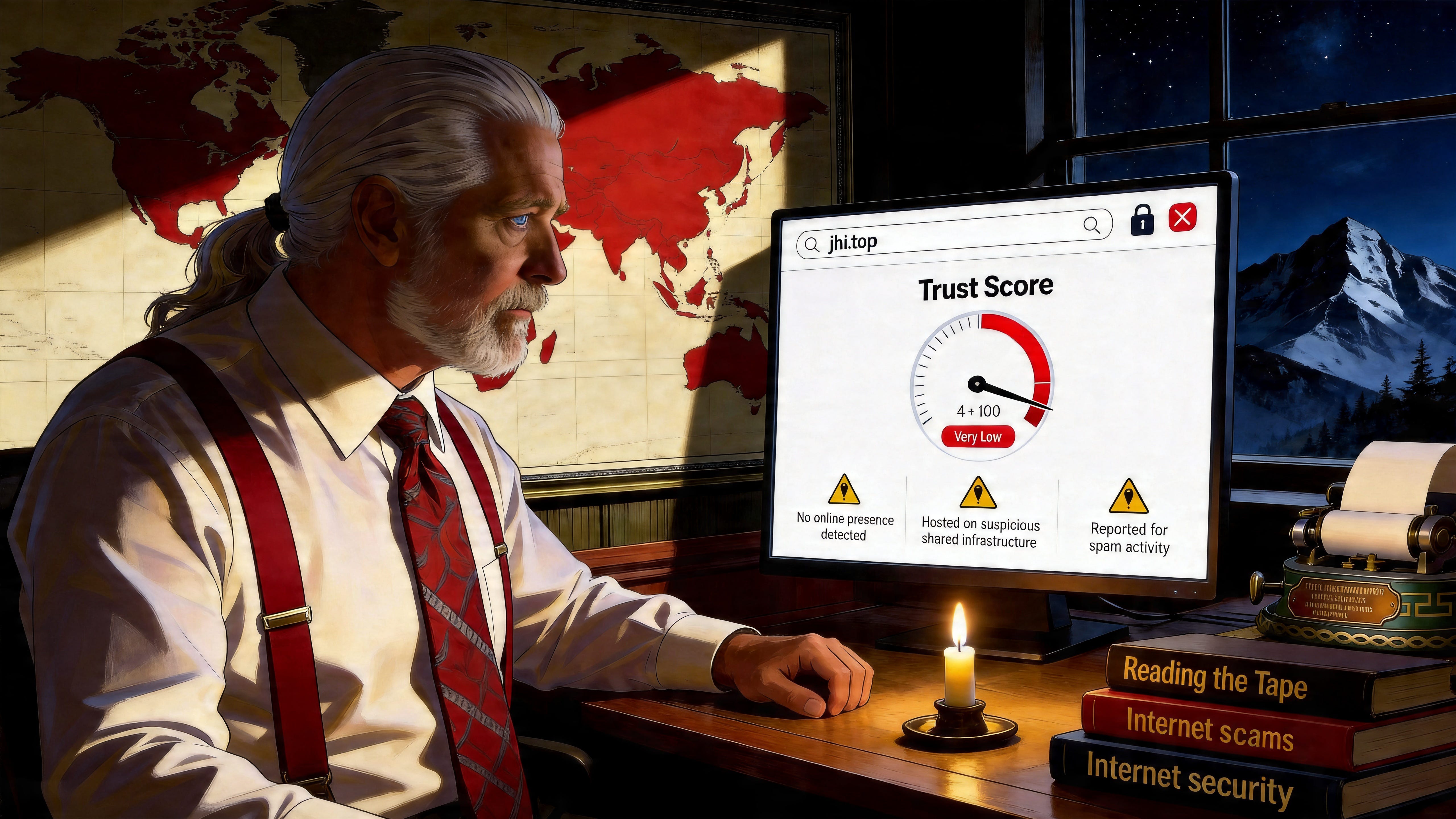
jhi.top is a ghost exchange. It doesn’t exist in any registry of legitimate platforms. It’s not on CoinMarketCap. It’s not on CoinGecko. ScamAdviser finds near-zero trust scores on related domains in the same naming family, flagging shared server infrastructure with other suspicious operations. There are no Reddit threads because the operation is intentionally ephemeral — built to vanish. No footprint is the whole point. Scam platforms in this category are disposable. They go up, they run a cycle, they go dark. There’s nothing to find because by the time anyone is searching, the operation has already moved. (Note there is another definition of “ghost exchange” or, more accurately, “ghost trading”, but I’m not getting into detail on that here.)
This invisibility is a feature of the scam, not a bug.
But consider the framework I discussed above to jhi.top — no index presence, no review trail, no footprint of any kind. If you’ve been around the Internet long enough, you’ll realize that any legit site is going to have left prints. Legitimate platforms, even obscure ones, generate sediment.
And as I said, the tape never lies.
Why Smart People Get Scammed
Here’s the thing I want you to understand, because it matters: the people who fall for this are not stupid. They are not unsophisticated. They are often exactly the kind of cautious, research-oriented person you would expect to be immune to scams.
But this type of scam works slowly. It draws you in carefully. The scammer cannot move too fast or give you every request up-front because the scammer knows that will spook their prey.
They want to make it easy and attractive to get in. Getting back out is the hard part.
The operation is called pig butchering — a term that originated in China and describes the process with clinical accuracy. You fatten the pig before the slaughter. The initial deposit is small. No arduous requirements to set up and start using an account. The platform looks professional. The gains are visible on screen. In some cases, an early withdrawal is actually permitted — a calculated move to build trust. See? You can take money out. This is real.

The psychological architecture here is sophisticated. These aren’t amateur hour phishing emails with bad grammar. The organizations running pig butchering operations — many based in Myanmar and Cambodia, operating from what are effectively forced-labor scam compounds — run them like businesses. There are scripts just like with AT&T or Cablevision when they’re working to scam you into the deal of the century on their products. There are quotas. There are managers. The person chatting you up about a great investment opportunity may themselves be a trafficking victim sitting in a building they can’t leave.
The scam works because it exploits a fundamental human cognitive bias: we anchor to what we can see. The dashboard shows a balance. The balance shows gains. The interface looks like Coinbase. What the mark cannot see is that the balance is fabricated — a number in a database controlled entirely by the scammer, bearing no relationship to any actual asset.
The ID Demand: What’s Actually Happening
When a platform demands a government ID to “verify your identity before withdrawal,” there are two things happening simultaneously.
First, it’s a stall. You’re not going to get your money. The ID requirement is a friction mechanism — buy time, collect more deposits, string the victim along. After the ID comes a “tax hold.” After the tax comes a “release fee.” After the fee comes a new obstacle. The goalposts never stop moving because there is no finish line. There was never going to be a large or a final withdrawal. Because the goal is to take money, not to give it away.
Second, it’s a data harvest. Your driver’s license — name, address, date of birth, license number, physical description — is valuable independent of the crypto scam. Identity theft is a second revenue stream. The same operation that stole your crypto investment may also open credit lines in your name six months later.
Do not send the ID. If you already have, treat your identity as compromised and act accordingly: credit freeze, monitor for new accounts, notify your bank.
Why There Are No Reddit Threads
Back to the original question. The absence of Reddit discussion about jhi.top isn’t because the platform is too obscure for anyone to have noticed. It’s because the operational lifespan of a site like this is short by design. These platforms are spun up fast — often using off-the-shelf trading platform templates available on dark web markets — pointed at a fresh domain, run for weeks or months, and then shut down or abandoned before victims have time to compare notes publicly.
The domain jhi.top generates no web index results, no review site entries, nothing. It has never accumulated the normal sediment of legitimate internet presence — no organic search traffic, no user-generated content, no business listings. By the time the first victim is angry enough to post on Reddit, the operation has likely already pivoted to a new domain.
This is why the FBI’s IC3, the FTC, and California’s DFPI all want reports filed immediately — not because you’re going to recover your money (you probably aren’t), but because rapid reporting helps investigators map the infrastructure before it moves. Like the tape, the blockchain doesn’t lie either. Every transaction leaves a trace. Forensic blockchain analysis has actually clawed back funds in some cases — but only when law enforcement can act quickly.
Reading the Tape on the Scam Itself
Let me put on my tape reader hat and give you the signals — the things that, in retrospect, are the equivalent of a stock that gaps up on no news, with no volume follow-through, at a price with no history.
And for these last parts of this post, I fed what I’d already written to an LLM and asked it to help generate quick kind of checklists based on my article and an Internet scan. I hate making bullet lists. So the bullets are AI-generated, though I removed some parts that I thought were wrong and tweaked some others. But after that, I approve of them or they wouldn’t be here.
No footprint anywhere. Legitimate platforms, even small ones, generate organic discussion. Zero results is not neutral — it is a red flag.
The initial amount was “small.” That’s the opening position. The intent is always to scale up.
Gains appeared on screen quickly. Real trading rarely works this way. Fake platforms can display any number they want.
Withdrawal triggers a new requirement. The first ask for fees or ID before you can withdraw, when it wasn’t required before, is the tell. Legitimate exchanges do not function this way.
The platform is unavailable on any recognized exchange registry. If it’s not on CoinMarketCap, CoinGecko, or verifiable through a regulated financial authority, it doesn’t exist in any meaningful sense.
Any one of these is worth a pause. All of them together is a hard stop.
What To Do
If you or someone you know has been victimized:
Stop. Don’t send more money. Don’t send the ID. Don’t pay the “tax.”
Document everything. Screenshots of the platform, wallet addresses, transaction IDs, all communications.
Report to FBI IC3 at ic3.gov
Report to FTC at reportfraud.ftc.gov
If you’re in California, report to DFPI at dfpi.ca.gov — they have an active crypto scam tracker and investigators with actual jurisdiction
If a credit card was used to purchase crypto, call the issuer immediately about a chargeback — time matters
Watch for the recovery scam. Someone may contact you offering to recover your lost funds for a fee. This is the third act of the same operation. Block and report.
The tape on jhi.top reads clean in all the wrong ways. There is no volume. There is no history. No footprint. No data.
That’s not a quiet or spoofed stock. It’s worse. That’s a dark pool designed to take your money and disappear.
If you want to support my writing so I can do more of it,
please consider buying me a coffee and subscribing!