


It seems fitting since this is the inaugural post for this particular Substack — Reading the Tape — that maybe I start off by talking about what Reading the Tape is all about and why I decided to create a Substack of that name.
The Tape Doesn’t Lie
Not long ago, I got interested in maybe retiring some day. I realized that I’d done something really stupid: I’d never thought about retirement. I kind of assumed I wasn’t going to live long enough for that.
I don’t know why. It’s just how I felt.
But now here I was getting closer to 70 than I am to 60 — or even 65! — so it occurred to me I might want to find out whether I even had enough money to retire. (I might.)
I found that I had a bunch of money — just over $100,000 — sitting and wasting away in a poor forgotten money market account at a local bank that was collecting a whopping $1.89 per month.
Yeah. I hear you. I said that same four-letter word.
So I decided to take a chunk of that money — $75,000 — and moved it to a brokerage account. I thought, “Well, I’ll maybe buy some stocks.” And I did. I bought a bunch of income ETFs. But I reserved a small portion to try my hand at some day trading.
I don’t know where I got the idea to do that. But I had some time on my hands as Google AI was doing its darndest to kill off my primary job and almost succeeding.
If I were going to do this kind of thing, I thought, I maybe should know a little bit about what day trading was. So I bought some books. Some were about “How to….” Some were about related things. One of those books I ran across was this really great copy of Reminiscences of a Stock Operator With New Commentary and Insights on the Life and Times of Jesse Livermore by Edwin LeFèvre, the Annotated Edition by Jon D. Markman.
If you have any interest in the stock market or history or just want to read a great book, I highly recommend it. In fact, I’m listening to it in my car now, even though I already read through it with the (absolutely magnificent) annotations. Maybe I’ll do a book review on it here later.
But what is a tape? What is a tape reader? And why did I title this section, “The Tape Doesn’t Lie”?
Back in the day, as we Old Timers say — back when Jesse Livermore was perhaps the greatest tape reader who ever lived — they had these ancient machines.
Ticker tape was the earliest electrical dedicated financial communications medium, transmitting stock price information over telegraph lines, in use from around 1870 to 1970. It consisted of a paper strip that ran through a machine called a stock ticker, which printed abbreviated company names as alphabetic symbols followed by numeric stock transaction price and volume information. The term “ticker” came from the sound made by the machine as it printed.
— Wikipedia, Ticker Tape (last visited March 15, 2026)
And Jesse Livermore was a “tape reader” extraordinaire.
In early 1929, he amassed huge short positions, using more than 100 stockbrokers to hide what he was doing. By the spring, he was down over $6 million on paper. However, upon the Wall Street Crash of 1929, he netted approximately $100 million.[6] Following a series of newspaper articles declaring him the “Great Bear of Wall Street”, he was blamed for the crash by the public and received death threats, leading him to hire an armed bodyguard.
— Wikipedia, Jessie Livermore: Career (last visited March 15, 2026)
According to Google AI, which is trying to put me out of business, $100 million in 1929 dollars would be $1.9 billion today. Imagine making $1.9 billion in one day.
But I feel like I’m distracting us from the point of this section.
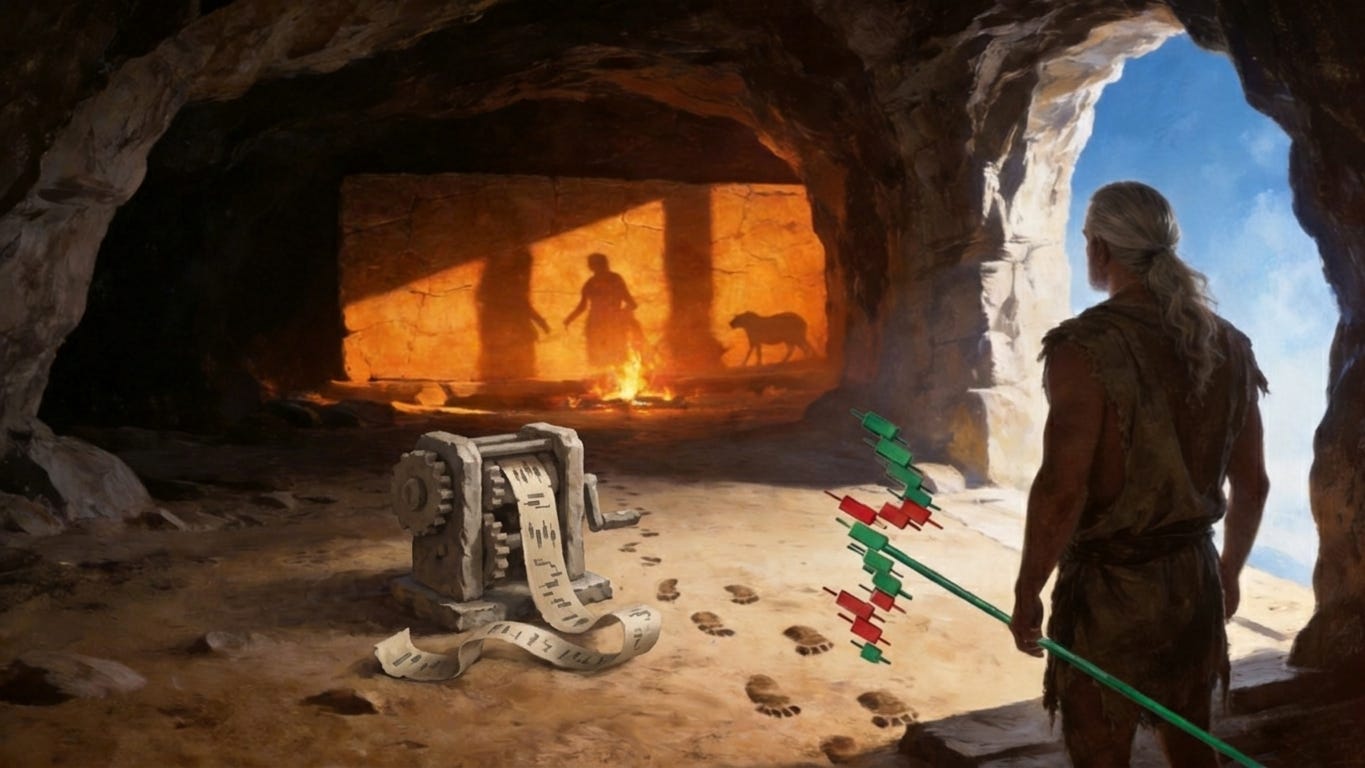
This ancient machine that generated the ticker tape used the telegraph to spit out price information. Livermore’s great skill was being able to “read” the tape and understand what was likely to happen to prices next.
The tape “explained’ the market to Livermore. In Reminiscences, mentioned above, he said that the tape did not lie. And the tape did not care what you thought. He said, “Don’t argue with the tape.” Nothing good could possibly come of it.
It is what it is.
There’s a lot behind the price that a tape prints. We’ll almost certainly get into that in some future posts. But the key point of this section is just to explain what the tape is: the tape is what prints reality.
My Footprints: My Tape
Here’s the thing about tapes: they’re everywhere, once you know what you’re looking for.
I’ve been a criminal defense lawyer in Fresno, California, for almost a quarter century (if you count my internships in law school — and you should, because I sat second chair on three “special circumstances” murder trials and argued before the 5th Appellate District Court before I ever took the Bar Exam).
On Probable Cause, I’ve written extensively about how the stock market fits hand-in-glove with criminal defense. Plea bargaining, in particular, I’ve compared to the process of the market finding the right price for a stock. I’ve talked about the pressure on buyers and sellers and defendants and prosecutors.
But I could easily go back even further than that. My work as an undergraduate student with McClelland & Rumelhart’s work on Parellel Processing and my membership in the Society for Philosophy & Pyschology, when I got to hang and — and get drunk with — numerous “big name” philosophers. (You haven’t lived until you’ve gotten drunk with a bunch of these folk and chatted about the origins or reality or non-reality of consciousness.)
I had sit-down conversations with Paul Churchland (I don’t remember him getting drunk). His wife, another well-known philosopher, Patricia. I read drafts of John Searle’s The Rediscovery of Mind (Amazon Affiliate link) before it was published. I discussed Sellars with one of my many mentors, who had co-written a book about Sellars’ philosophy. (Amazon Affiliate link.)

I wrote a letter to Endel Tulving — a cognitive psychologist at the University of Toronto who was then rewriting how scientists understood human memory — because something he'd published in Nature had stopped me cold. I thought about my own life story which, in some ways, didn’t really exist. In my letter, I explained that I had a theory about why certain things they were finding in their work might be happening. My idea was slightly different than what he had posited in the article. And I explained that I’d been actually thinking of this a lot because of how my brain is very good at remembering concepts, theories, and ideas, but not so good at remembering where I learned them: just last week, I started explaining the concepts behind some books I’m reading to a friend at lunch. Embarrassingly, he reminded me that he was the one who introduced me to the books!
Tulving told me that his team had started thinking about the same idea I was discussing with him. They eventually figured out that "remembering an event from your life" and "knowing a fact" are two completely different systems in the brain. Tulving’s ultimate distinction between episodic memory (remembering events from your own life) and semantic memory (remembering concepts and facts without necessarily remembering where or how you learned them) became foundational to everything that followed in neuroscience and psychology.
I’m not going to say that I presaged this theory. I didn’t. I did suggest that there might be these different kinds of memories and that some people were better equipped — due to their particular brain structures — than others at one or the other. What Tulving’s work eventually led to was the discovery that some healthy, high-functioning people naturally strip episodic context from information and retain only the pattern. They named it SDAM. I apparently have it.
Expanding the Tape Reading Universe
After realizing the added benefit of being apparently a natural at “tape reading”, that is why I first decided to start talking about markets and criminal defense, and then, when I wanted to write more general articles, it’s why I latched onto the title Reading the Tape for my new Substack.
“Larry Livingston”, generally accepted as the stand-in, slightly fictionalized version of Jesse Livermore, was an exceptional “tape reader” with regard to the stock markets. But I realized in reading Reminiscences of a Stock Operator that — although he never labeled this as a piece of his tape reading — that the importation of events (such as the San Francisco earthquake and its subsequent impact on railroads and their stocks, or the sinking of the Lusitania and the market for coffee beans) was another piece of tape reading.
I don’t know if Jesse had SDAM. Reminiscences make me think he did not. But he was definitely applying his skills at tape reading to other areas of life.
Above, I mentioned that I first started realizing that my own reading of the tape applied to a wider universe than just that of Time & Sales in thinkorswim. I’ve been reading a different tape for 25 years without knowing that’s what it was called. I began to see the correlation between markets and how the modern criminal-judicial complex work. Witness behavior, prosecutorial tells, jury patterns. Same skill, different instrument.
Shadows on the Cave’s Wall

My philosophy background reminded me of something else: In Plato’s Allegory of the Cave, the shadows represent the lowest level of human understanding and perception of reality. Chained prisoners in an underground cave see only these shadows projected on a wall, which are created by a fire behind them casting light on objects carried along a raised walkway.
The prisoners believe the shadows are the only true reality because they have never seen the actual objects casting them. They are unable to turn their heads to see the fire. Because of this, they never understand that their sense of reality is incomplete. Even when the “shadows” speak, their voices echo off the walls — the very walls that provide the “screen” for them to see the shadows in the first place — and to them, it is the shadows which are producing the sounds.
There’s no need here to get into all the details of Plato’s thinking on this. I’ve come to realize that my whole life has been driven by a recognition that there is more to the world — my cave — and that I’ve always been looking for the cause.
I even remember when it started: the day when, as a very young child, I walked into my parents’ bedroom and found my mother lying on the bed, crying. I asked what was wrong. Her reply that “nothing” was wrong threw me into a state of confusion. I was young, but not so young that I didn’t realize that a person crying indicated that something was wrong for the person crying.
And, of course, something was wrong. She just didn’t want — for whatever reason I’ll never know — me to know. She wanted me to believe something different than my own read of the tape.
This would become a major trend pattern in my childhood.
The Deliberate Reading of the Tape
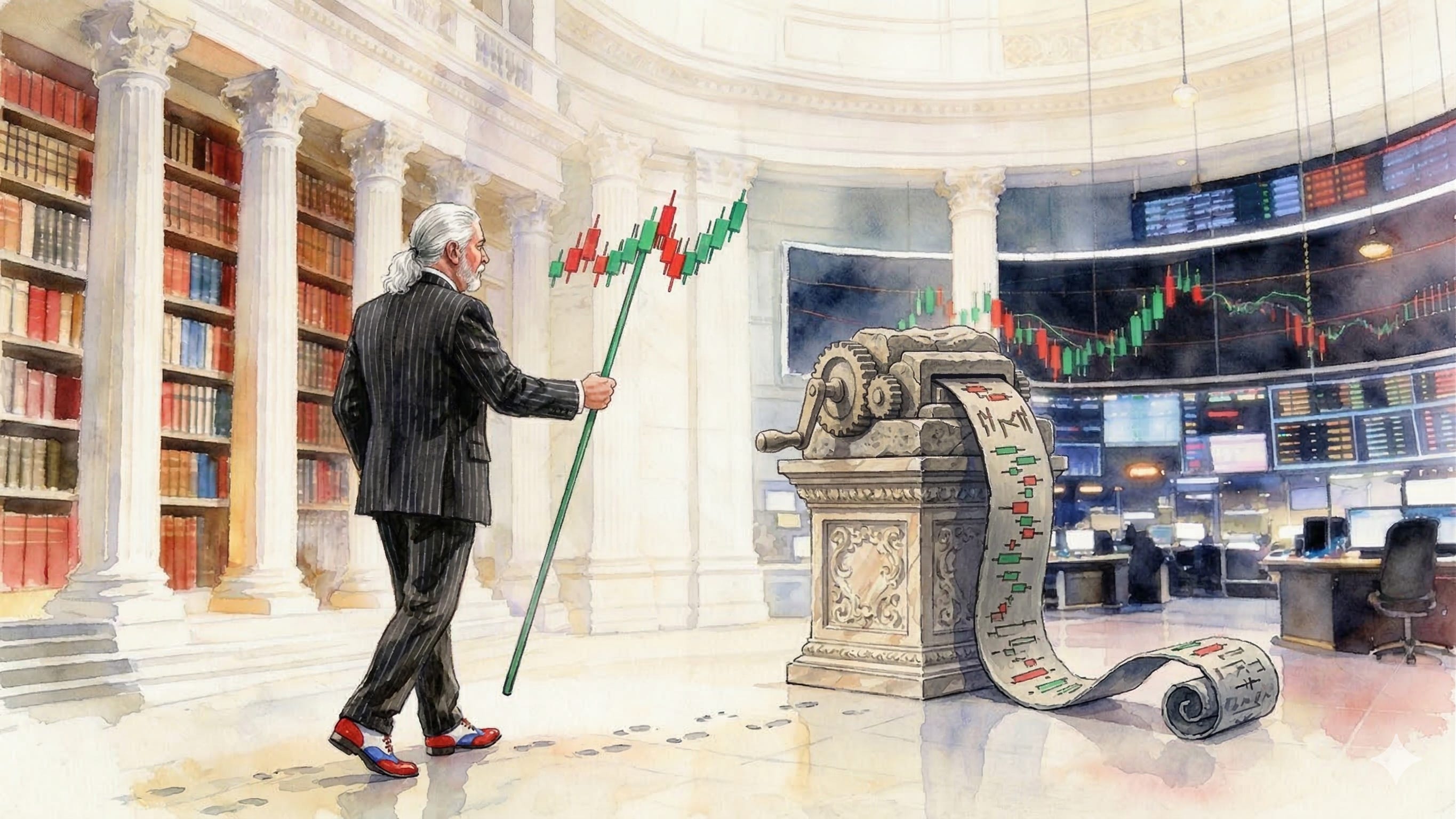
So here I am: my lifelong quest has been to understand the reality behind the thing I can actually see. I can see what people do; I strive to understand why they did them. I can see patterns all around me; I want to know the potential impact on my life before the impact arrives. To be prepared in advance and make myself safe.
In Anne Tyler’s The Accidental Tourist, the protagonist Macon Leary spends his life writing guidebooks for people who hate to travel — people who want to move through the world without ever truly touching it, “encased” in the safety of the familiar. For years, I was a version of that traveler. I was an accidental tape reader, instinctively decoding the shadows on the wall to protect myself from the misdirected “nothing’s wrong” of my early life, yet I was still fundamentally passive regarding the patterns I saw.
I became very good at reading the tape without realizing that that is exactly what I was doing.
But there comes a point where, like Macon, you have to stop trying to alphabetize the chaos and instead choose to step into the mess of it.
The stock market, by introducing me to the concept of reading the tape, has helped me to more clearly say what it is that I’ve been doing all my life. From reading the books about reading the market — and my own apparent abilities with reading the tape — I’ve evolved from an accidental tape reader into one who has a better understanding of what my life is about.
By finally naming the skill, I’ve moved into the deliberate reading of the tape. I am no longer just a passenger trying to avoid the bumps; I am a participant who understands that the tape isn’t just printing prices or court transcripts — it’s printing the very fabric of the life I am finally choosing to lead.
And it only took 68 years.
Oh, well. As one of my favorite philosophers when I was younger once said — in a statement that both explains a bit why it’s taken me 68 years to evolve into a recognition that I’m a tape reader, but also why reading the tape is necessary:
Life can only be understood backwards, but it must Be lived forwards.
— Søren Kierkegaard, 2 Kierkegaard’s Journals and Notebooks: Journals EE–KK 179 (Alastair Hannay et al. eds., Bruce H. Kirmmse trans., Princeton Univ. Press 2008) (1843)
And with that — our inaugural article for Reading the Tape complete — I already have my next article in which I anticipated that a certain someone was lying when he said a certain thing and so avoided the trap when the markets temporarily bounced a little on the lie.
You have a beautiful mind, Rick, and I'm heartened to learn you are finally understanding it.